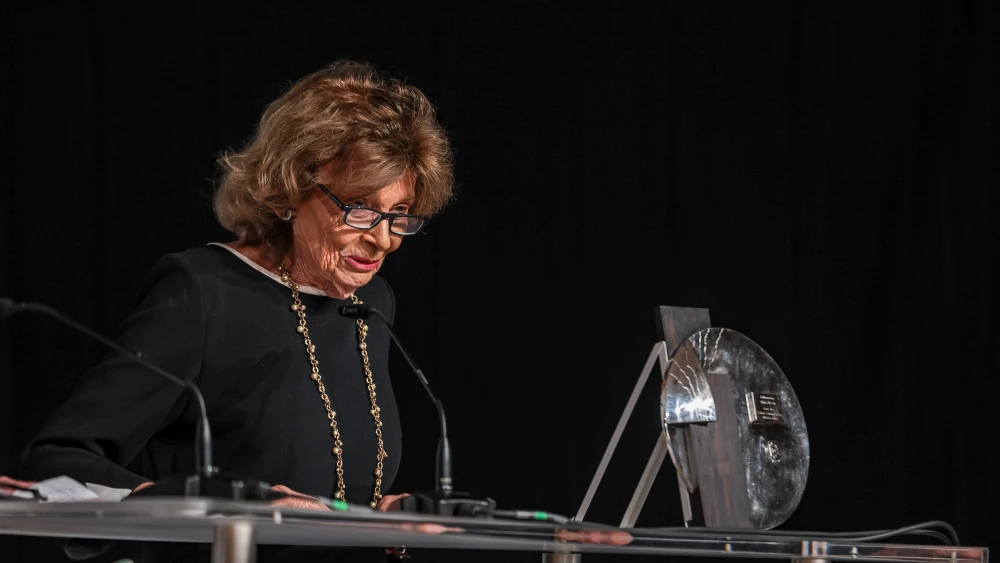
Police in Munich are investigating a death threat against Charlotte Knobloch, a Jewish community leader and Holocaust survivor, referencing recent electoral gains by the right-wing AfD Party.
A woman noticed the threat scrawled on a park bench on Thursday and reported it to police, dpa reported. Knobloch, who has called for banning the AfD, canceled her attendance at a book launch that had been scheduled to take place on Thursday about 2 miles away from where the threat was found, the German news agency reported.
AfD, Alternative für Deutschland, last week won 43.8% of the vote in the state election of Saxony-Anhalt, garnering 39 seats in the local parliament and falling just shy of being able to form a majority government without a coalition partner.
German media did not report the exact content of the death threat. It referenced Knobloch, the AfD, and featured a Star of David, according to reports.
Stephan Protschka, state chairman of the AfD’s Bavaria chapter, wrote in reply to a JNS query about the incident: “I condemn the death threat against Charlotte Knobloch unequivocally and without reservation. Political disagreements or election results can never justify threats, intimidation, or violence against a person. This applies, of course, especially if such a threat is motivated by antisemitism.”
Protschka continued, “We take very seriously the fact that the graffiti explicitly referenced the AfD’s election success in Saxony-Anhalt. At the same time, the relevant authorities are investigating the perpetrator(s) and the background of the act. The results of this investigation should be awaited before any further conclusions are drawn.”
Ludwig Spaenle, the Bavarian State Government Commissioner for Jewish Life and Against Antisemitism, said the death threat “crossed every line of decency.” Speaking to dpa, he added: “To threaten a person who, after the Shoah, opened a door to this country’s return to the civilized world with her family in Munich and Germany, is more than just breaking a taboo.” He added that he hoped that the perpetrators would be quickly identified and brought to justice.
Knobloch in 2019 singled out the AfD in a speech during a Holocaust commemoration at the Bavarian State Parliament. The speech received considerable media attention because it was a departure from the custom of not bringing politics into such events. The “so-called Alternative for Germany bases its policy on hatred and exclusion,” she said in her speech.
AfD seeks to limit immigration to Germany and has had supporters and leaders who downplayed the Holocaust.
Knobloch is widely credited with leading a Jewish revival in Munich, where she was born. She spearheaded the establishment in 2006 of a $51 million Jewish community center and synagogue. She began focusing on that project after leading the communal effort to absorb thousands of Jewish immigrants from the former Soviet Union.
In 1942, when she was 10, Knobloch’s father, Fritz Neuland, arranged for her to go into hiding in a small town with the family of a Catholic woman. Rumors circulated that Knobloch was the illegitimate daughter of that woman, Kreszentia Hummel. She did not deny the rumors, which helped shield both guest and host from being reported to Nazi authorities.
Knobloch’s mother abandoned her and her father when Knobloch was very young. Knobloch and her father, who also survived the Holocaust, returned to Munich after the war. There were almost no Jews in a city whose Jewish population had numbered 10,000 in 1933.