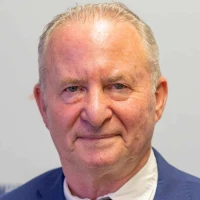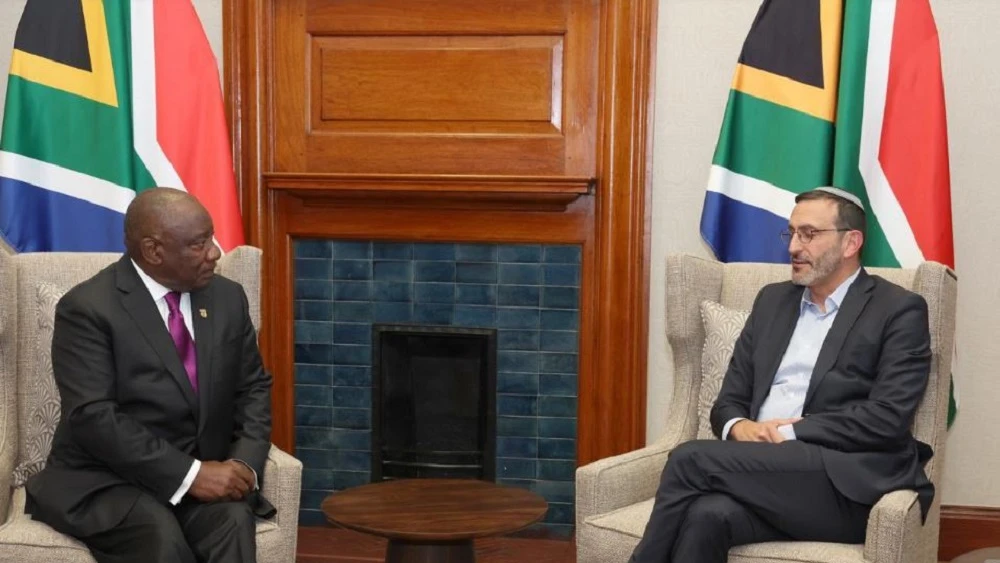
South African President Cyril Ramaphosa met in Pretoria on Monday with Rabbi Doron Perez and his wife, Shelley, the parents of slain Israel Defense Forces Capt. Daniel Perez, 22, following what was described by the presidential office as “the intervention of the South African government in facilitating the release of his remains by Hamas.” It did not elaborate.
Perez, who serves as president of the World Zionist Organization and executive chairman of the World Mizrachi movement, confirmed the South African government’s role, saying that he and his wife met Ramaphosa in his office to express their “heartfelt gratitude” for the government’s behind-the-scenes efforts to return their son’s remains to Israel for burial.
“Without the direct intervention of the president and the S.A. government, our son’s body would in all likelihood have come back months later, causing us additional pain and suffering,” Perez wrote on Instagram. “Amid geopolitical complexity and division, humanitarian considerations often shine through and ought to rise above all else. This meeting stemmed from the profound spirit of both South African ubuntu and the Jewish value of hakarat hatov—expressing personal appreciation.”

Pretoria’s presidential spokesman Vincent Magwenya said in a statement, “President Ramaphosa expresses his condolences to the Perez family and affirms South Africa’s support for an all-inclusive peace process that will deliver a lasting peace for the people of Israel and Palestine.”
He added, “The South African government remains engaged in assisting all South Africans, irrespective of race or religion, that are ensnared in conflict zones, as well as assisting other foreign nationals where such support is requested.”
Daniel Perez was born in Johannesburg and grew up in the Glenhazel neighborhood, where his father served as a community rabbi and educator for 15 years. The family moved to Israel in 2014, shortly after Daniel’s bar mitzvah, and settled in Yad Binyamin in central Israel.
They have three other children: Yonatan, Adina and Shira. Daniel’s older brother, Yonatan, also served as an IDF officer and was wounded fighting Hamas terrorists on Oct. 7, 2023. He went ahead with his planned wedding shortly afterward while Daniel was still listed as missing, and later named his firstborn son after his brother.
Daniel served as a platoon commander in the 77th Battalion of the IDF’s 7th Armored Brigade. On Oct. 7, he and his tank crew fought Hamas terrorists for more than two hours in defense of the Nahal Oz military post and nearby communities before their tank was overrun.
Daniel was initially classified as a hostage, and for 163 days his family believed he might still be alive, campaigning in Israel and abroad for his release. On March 17, 2024, the IDF informed the Perez family that it had determined he was killed on Oct. 7 and that Hamas was holding his body in Gaza.
The following day, after the IDF’s chief rabbi determined there was sufficient evidence to permit a burial, the family held a funeral at the Mount Herzl Military Cemetery in Jerusalem. Daniel Perez’s remains were returned to Israel by Hamas on Oct. 13, 2025, two years after the Oct. 7 attack, and a second funeral was held at Mount Herzl two days later.
South Africa, which has hosted Hamas leaders, backed international legal action against Israeli leaders and has been one of Israel’s most vocal critics over the Gaza war.
The South African intervention came despite extremely strained relations between Pretoria and Jerusalem since the Oct. 7 massacre. Pretoria recalled its ambassador from Israel in November 2023 and declared Israel’s chargé d’affaires persona non grata. The following month, it filed a case at the International Court of Justice, accusing Israel of genocide in Gaza. Jerusalem, which categorically rejected the claim, also recalled its envoy from Pretoria.
In an interview with JNS on July 27, Perez reflected on the principle that sustained his family through Daniel’s death and the long wait for his return.
“We’ve never lost hope,” he said. “Jonathan Sacks often said perhaps what defines the Jewish people more than any other quality is hope. We should be experts in suffering, but instead we’re experts in hope.”