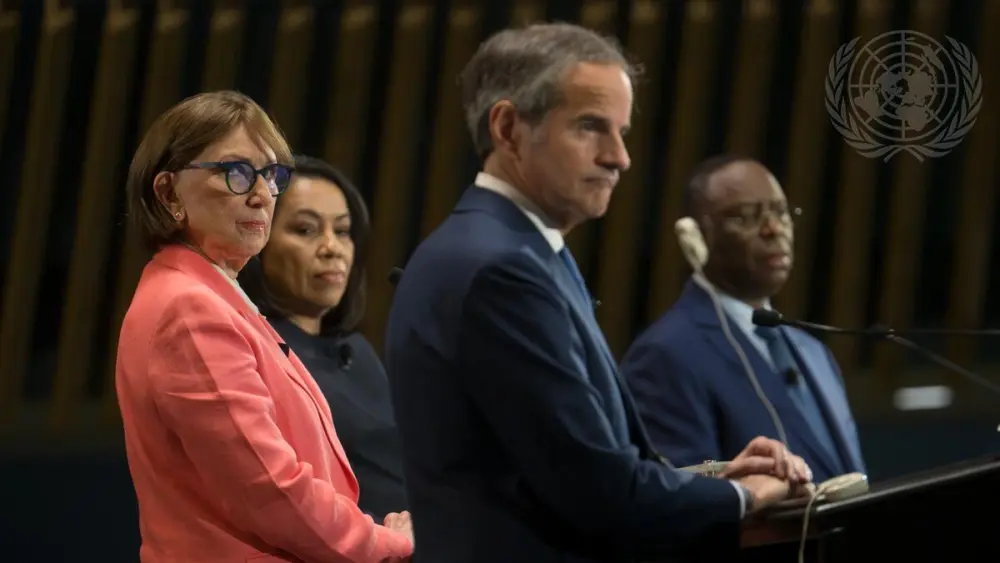
Rebeca Grynspan, a Jewish economist and United Nations executive, fell to second place in a second round of U.N. Security Council straw polling to select the global body’s next secretary-general.
The non-binding poll among the 15 council members is meant to gauge levels of support for the candidates and determine whether there is a chance for consensus. Further rounds are expected.
Grynspan is the daughter of Holocaust refugees and has ties to Israel. She is the former vice president of Costa Rica and is a longtime U.N. executive and the secretary-general of the U.N. Trade and Development agency.
During a U.N. hearing for candidates a few months ago, Grynspan, whose parents fled Poland during the Holocaust, opened by describing herself as a “product of peace.”
Her parents immigrated in the aftermath of World War II, she said.
Grynspan has decried Holocaust denial, has family connections to Israel and studied economics and sociology at the Hebrew University of Jerusalem. But she has spoken little about her Jewish identity.
She is largely considered to be moderate toward Israel, even as she harshly criticized the Jewish state in the early stages of the Israel-Hamas war.
On Friday, Grynspan received seven “encourage” and four “discourage” votes, along with four “no opinion” votes. That’s a steep drop from the 10 “encourage,” one “discourage” and four “no opinion” votes from the first round in late July.
The “discourage” votes are particularly important in the council’s straw polling, as they indicate opposition to a candidate.
If even one of those “discourage” votes comes from one of the five permanent members—the United States, China, France, Russia and the United Kingdom—it could doom a nominee’s chances.
Secret ballot
All voting is held via secret ballot, and later rounds will include color-coded envelopes for the five permanent members to help better determine who votes “discourage.”
There is no public indication yet if any permanent members voted “discourage” with respect to her candidacy.
Carolyn Rodrigues-Birkett, of Guyana, won Friday’s straw poll with eight “encourage,” three “discourage” and four “no opinion” votes. (Although she won, Rodrigues-Birkett actually fared better in the initial July poll, with nine “encourage,” two “discourage” and four “no opinion” votes.)
Rodrigues-Birkett was her country’s first female foreign affairs minister and served on the U.N. Security Council. She also previously chaired the G77 coalition of developing countries.
Rafael Grossi of Argentina, head of the International Atomic Energy Agency, struggled on Friday, with seven “encourage,” six “discourage” and two “no opinion” votes.
María Fernanda Espinosa, of Ecuador, a former U.N. General Assembly president and Ecuadorian foreign affairs and defense minister, held steady with four “encourage,” three “discourage” and eight “no opinion” votes. The latter suggested she still has room to shape opinions.
Michelle Bachelet, of Chile, an anti-Israel candidate and former U.N. official, logged only two “encourage” votes against six “discourage” and seven “no opinion” votes.
Ivonne Baki, a late entrant into the race, received not a single “encourage” vote while logging eight “discourage” votes, likely putting her run to a quick end.
An Ecuadorian politician and diplomat, Baki has personal ties to U.S. President Donald Trump and is of Lebanese heritage. She is billing her candidacy as one that can help build global bridges.
A pair of African male candidates received high numbers of “discourage” votes in a year where the field is tilting toward female, Latin American nominees.
“The election for the next secretary-general is a test for the future of the United Nations,” stated Danny Danon, Israeli ambassador to the United Nations.
“After years of bias, failure and eroded trust, the organization needs a leader who is prepared to change the system,” the Israeli envoy said.
“Israel will evaluate the candidates based on their record and their willingness to stand up to terrorism, antisemitism and hypocrisy,” he said.
Israel has not announced support for any candidate nor has it commented publicly on any nominee.