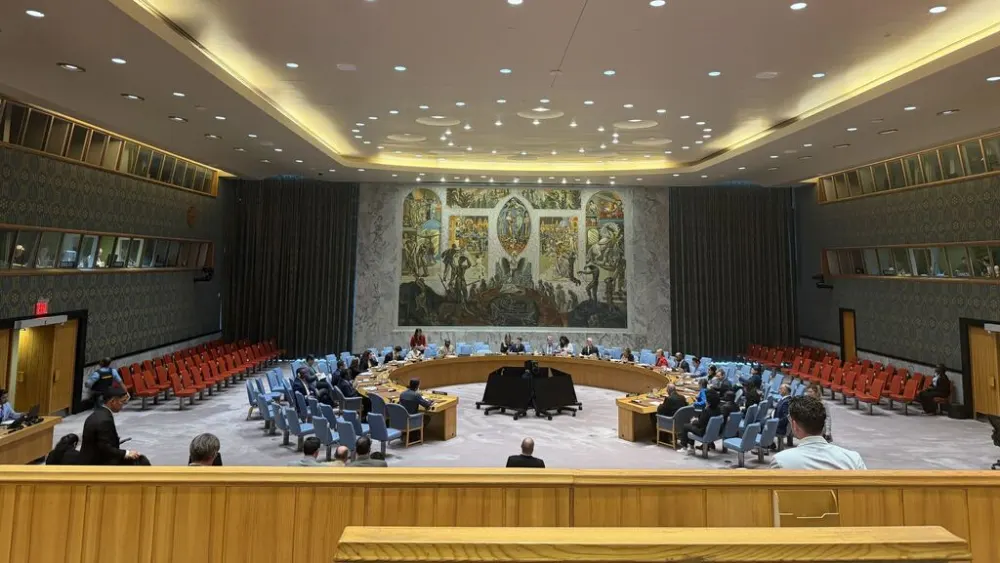
Israeli Ambassador to the United Nations Danny Danon called on Wednesday for changes to the U.N. Security Council’s process for convening emergency meetings, which he said has become a political tool used disproportionately against the Jewish state.
“It shouldn’t be that you just send a fax or email and you have a session,” Danon told JNS, ahead of his remarks. “It should be not only one country, maybe three countries, and actually use it when it’s needed, not for political usage.”
Danon spoke to JNS in the Qatari lounge shortly before addressing the Security Council on Wednesday afternoon.
He proposed requiring the support of three council members to convene an emergency meeting, rather than allowing a single member to request one, and to establish clearer criteria for what constitutes an “emergency.”
The Security Council has held about 100 meetings about Israel over the past four years, including at least 17 “emergency” sessions, according to the envoy.
Iranian aggression, Houthi attacks on international shipping routes, Hamas’s holding of hostages and Turkey’s military entrenchment in Syria have rarely prompted emergency meetings, he told JNS.
“Today, the debate is more about procedure in the Security Council,” he said. “For a change, it’s not about us. I will focus my speech on the fact that the U.N. Council is not focusing on the right issues. They focus on Israel.”
Whenever council members want to criticize the Jewish state, they simply “call for an emergency session, but there is no emergency,” Danon said.
“The entire U.N. today—they focus their energy not in the right places,” he told JNS. “It’s more about the debate. It’s more about bashing Israel, less about concrete efforts, practical solutions and confronting the bad guys.”
He pointed to recent “emergency” meetings over Israel’s recognition of Somaliland and what he said was “so-called settler violence.” Those sessions came in addition to the council’s regular monthly discussions on Israel, he said.
“When we recognized Somaliland, we had to come to an emergency session, and they blamed us for wanting to expel the Palestinians, which is a joke,” he told JNS.
The emergency sessions, Danon added, take time away from what he sees as more pressing action against terrorist groups.
“They were not able to designate Hamas. They were not able to designate Hezbollah, the Houthis,” he told JNS. “So instead of doing those things, they are putting the time on us.”
In his formal remarks, Danon said that the council had become “very good at holding meetings but very bad at making a difference.”
“Instead of focusing its time on Iran, Hamas, Hezbollah and the Houthis, it is repeatedly drawn into political theater,” he told the council.
“The Security Council was not created to hold fruitless meetings,” he said. “It was created to prevent wars. It is time to return to the mission for which it was established.”