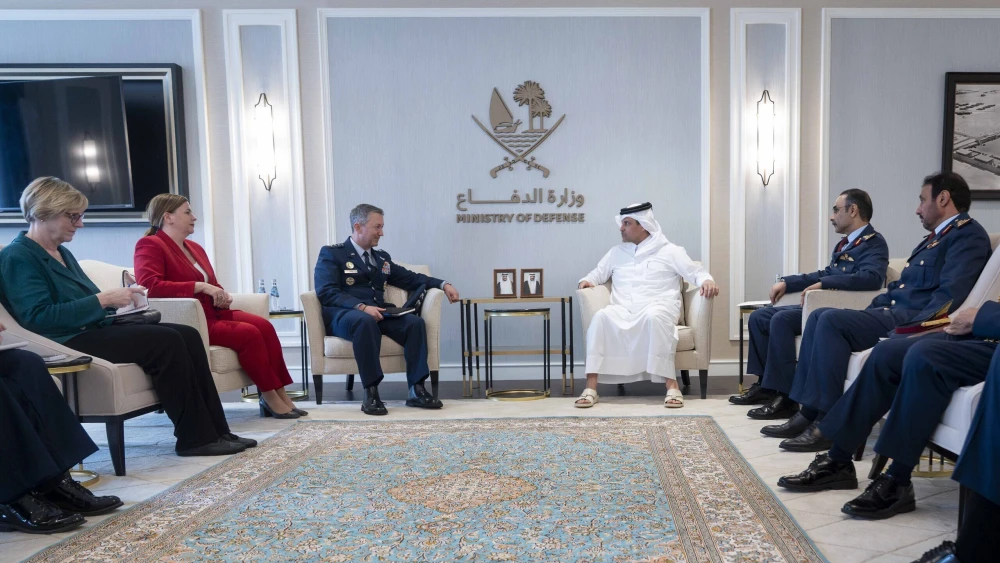

There are multiple reasons why selecting Qatar as a negotiator for U.S.-Iranian talks is problematic. For starters, it has constantly supported Hamas and the Muslim Brotherhood financially and politically over the years, which means that their ideology slants in favor of radical Islam and not towards the West.
For years, Qatar has tried to project itself as a mid-size power, but it does not have all of the necessary means to be one. It is a small country with a small population and lacks the mandate to speak for Arab countries.
Yet since the Arab Spring of 2011, Doha has been pushing to be involved in the internal affairs of Libya, Tunisia, and especially Egypt, despite the fact that influential Arab powers such as Saudi Arabia, the United Arab Emirates and Egypt were clearly against Qatar’s ambition.
Since the aftermath of the Arab Spring and following the fall of former Egyptian President Mohamed Morsi, Qatar has been losing all its investments in the Muslim Brotherhood throughout the Arab world.
Lately, it has turned into a savior of Hamas by playing the role of a “mediator” between Washington and Tehran. Iran, on the other hand, is not necessarily pro-Hamas as a Shia country. It only intends to support the Muslim Brotherhood as long as it serves the Islamic Republic’s interests.
In other words, Iran at this point supports Hamas against Israel and played a critical role in supporting the terrorist attacks in southern Israel on Oct. 7, 2023. Former Ayatollah Ali Khamenei openly came out and said that he would kiss the hands of those who committed the Oct. 7 massacre. By mediating between the United States and Iran, Qatar is working to support radical Islam, which hinders support for moderate Muslims and Western democracies.
This is not unbiased mediation. Qatar is trying to save Iran from further setbacks.
The Qataris also have been helping Hamas leaders for quite some time now. It has provided Hamas with political shelter, financial transfers and diplomatic backing, serving as the group’s primary foreign backer while acting as an international mediator. It has hosted the political office of Hamas in Doha since 2012.
Senior Hamas political figures, such as Khaled Mashaal and Ismail Haniyeh, have utilized Doha as their operational base. Qatar has transferred more than $1.8 billion into the Gaza Strip over the years. While the Saudis and other Arab countries also give a lot of money to help Gaza, the Saudis try to help the Palestinian people, while the Qataris care mainly about helping Hamas and care less about the Palestinians.
Saudi Arabia and Egypt, who are the main leaders in the Muslim world, do care more about Palestinians than Hamas. They both want Hamas to be dismantled and for “moderate” Palestinians to take over. Saudi Arabia and most Arab countries, except for Qatar, are not against Israel’s existence.
Trying to mediate between the United States and Iran has major questions about its intentions that go unanswered. How can the world trust Qatar to be a mediator when the Gulf state has its own agenda that is helping Iran? When Saudi Arabia and other Arab nations in the region blockaded Qatar for supporting the Muslim Brotherhood during the Arab Spring protests, Iran was the only country that opened its airspace to help the Qataris. Qatar is one of the biggest culprits that caused the Arab Spring not to succeed because it supports Islamist fanaticism.
This country has been working to help the mullahs’ regime for the 47 years of the Islamic Republic’s existence. Therefore, it is hard to trust that the Qataris will be honest brokers in mediations with the United States.
The entire Iranian population, including South Azerbaijanis and other ethno-national groups, is suffering under the tyranny of the mullahs in Tehran. None of them want Qatar to hand this regime a life vest. These populations want Trump to go back to fighting the regime rather than engaging in fruitless negotiations, which are clearly serving the Islamic Republic so far.
The goal should be to weaken and topple the regime, instead of giving Iran another lifeline.