
Hatred of Jews is very old, but the words used to sanitize it are decidedly new because they are constantly evolving. Observing this evolution is one of the best methods of seeing how Jew-hatred transforms its appearance without changing its character.
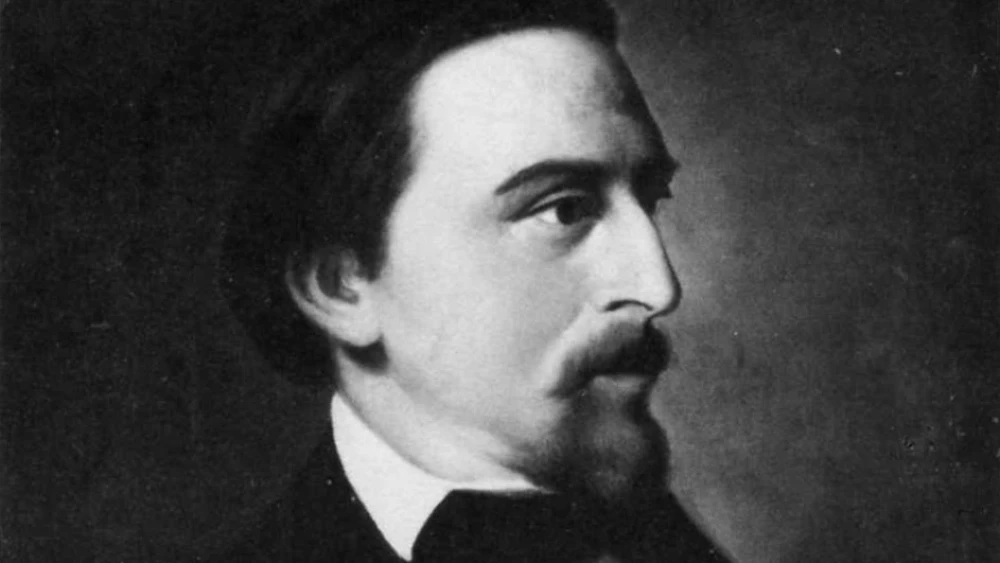
The phenomenon’s origin point is likely 1879, when a struggling Hamburg journalist named Wilhelm Marr published a pamphlet called The Victory of Jewry over Germandom and founded the Antisemiten-Liga, the League of Antisemites, in Berlin. He is remembered today because he deployed the word Antisemitismus—“antisemitism.”
But this is something of a myth. The true story of the word “antisemitism” and the words that came after it is more interesting and useful.
It’s possible that Marr didn’t even coin the term. Antisemitismus appears to have been in documented use before 1879. Marr, who was not a modest man, never claimed authorship of it in his memoirs. What he did do was to take a word already circulating in scholarly and encyclopedic writing, and attach it to an organized political movement—one built to look like racial science rather than religious bigotry.
Marr’s reasons were strategic. They grew out of his rivalry with Adolf Stoecker, the court chaplain whose anti-Jewish agitation was explicitly Christian. To separate himself from Stoecker, Marr needed a secular brand of the old hatred.
The word he reached for, Antisemitismus, already carried the prestige of contemporary philology, letting him present hostility towards Jews not necessarily as an emotional prejudice, but as an objective diagnosis. The word sounded scientific, almost clinical. Now, one didn’t have to say, “I hate Jews.” Instead, one held a considered and thus allegedly legitimate position on the “Jewish question.”
None of this required Marr to consciously think, “I will make Jew-hatred sound respectable.” He was solving an immediate branding problem. The laundering effect was a byproduct, not the plan. That distinction matters: to solve a narrow problem, someone can, without meaning to, launder something much larger. Once the public adopts the terminology, a word carries on, doing the work by itself.
Marr’s own life underscored the contradictions of his racial worldview.
He married four times, and at least two of his wives had some Jewish ancestry. His second wife, Helene Behrend, whom he genuinely loved, died in childbirth. In his memoirs, he simultaneously praised her “pure” Jewish blood and warned against “the mingling of Aryan and Semitic blood,” illustrating how even personal intimacy can coexist with ideological obsession. The man who gave Europe a clinical new name for its oldest hatred built his authority to speak on the subject upon a marriage he mourned.
By 1891, 12 years after founding the Antisemiten-Liga, Marr did something almost nobody expected of him: he wrote a document called “The Testament of an Anti-Semite” in which he disavowed the movement he founded. He acknowledged that the social dislocations of his era had been caused by industrialization, not by Jews. He asked, in effect, to be forgiven for having “explained” the problem incorrectly. Almost nobody noticed. The word had already left Marr’s hands. It would keep working without him for the next half-century, becoming part of the political vocabulary that the Nazis would inherit.
Once the public adopts the terminology, a word carries on, doing the work by itself.
This is the part of the story that’s worth our attention now because the process didn’t disappear with Marr. Often, when a hatred becomes too costly to express in explicit terms, its carriers find new words that go down easier with the public because they are vaguer and, in some cases, come with less baggage. After the Holocaust, explicit antisemitism became increasingly socially unacceptable in much of the West. As a result, hostility towards Jews adopted a new vocabulary, including certain forms of anti-Zionism.
After the 1967 Six-Day War, the Soviet Union launched an extensive anti-Zionist campaign through Soviet propaganda organs and allied communist parties, recasting Zionism as racism, colonialism and fascism. This campaign was fused with the PLO’s Third World diplomatic efforts to frame Israel as a colonial outpost akin to apartheid South Africa.
The campaign culminated in the 1975 “Zionism is racism” resolution in the United Nations, which was repealed in 1991. The vocabulary it helped establish, however, never went away. Scholars like Izabella Tabarovsky have traced how these specific Soviet-era tropes migrated westward and settled into contemporary left-wing discourse, where they now circulate largely detached from their origin.
This history is not, however, a definitive indictment: not every critic of Israeli policy is a bigot, nor are all things that generally fall under the umbrella of Zionism immune from argument. Objecting to a government and issues related to war or policy is not antisemitism, and pretending otherwise cheapens the charge.
But when “anti-Zionism” is used to demand that only one national community forfeit the right to self-determination granted to all others, it becomes a selective application of the principle. For example, it asserts that Israel’s founding is illegitimate according to standards never applied to similar nations founded amid intercommunal conflict that persists to this day.
There is, for instance, Pakistan, whose creation displaced millions amid horrific communal violence. Yet few argue that those events make Pakistan permanently illegitimate as a state. This selective application of universal principles is not new. It is Marr’s logic rebranded: collective blame, double standards and a vocabulary abstract enough to make old hatreds sound like sophisticated new arguments.
Marr took the first step in 1879. Contemporary uses of “anti-Zionism” represent the next evolution in language. It is a new vocabulary adopted because “antisemitism” can no longer serve as sufficient cover for bigotry. Those employing it need not consciously emulate Marr; the language launders itself.
Call it the “Marr Effect.”