
Ireland stands at a crossroads when it comes to its Jewish community. One path leads to growing isolation, discrimination and fear. The other leads to a future in which Jews can live openly and proudly, confident in their identity and their place in Irish society. Which path Ireland takes will depend not only on how it responds to antisemitic incidents, but on whether it confronts the conditions that allow them to happen.
The challenges facing Ireland’s Jews are not unique. Across Europe and in the United States, Jewish communities are increasingly confronting questions about their identity, belonging and security. What is happening in Ireland should concern anyone committed to protecting Jewish life and the fabric of democratic societies.
Earlier this month, I gathered with 300 public and elected officials, members of the Jewish community and non-Jewish allies in Dublin to mark the three years since the Hamas-led terrorist attacks in southern Israel on Oct. 7, 2023. In the days that followed, I joined the World Jewish Congress and the European Commission for an international gathering of Jewish and government leaders focused on combating antisemitism.
As the conference was concluding, we learned that ahead of the gathering, a Dublin hotel had canceled 70 rooms reserved for participants, reportedly after questioning whether the event had connections to the Israeli military. The irony of antisemitism striking an event designed to address it was painful. But solely focusing on the hotel’s actions risks missing the larger issue.
Ireland is hardly an isolated case. Over the past year, similar incidents of exclusion have emerged across Europe and beyond. In Germany, a hotel told an Israeli family that Jews were not welcome. In Spain, two Jewish women were reportedly denied entry to a sauna after being questioned about their views on Zionism. In the United States, a Jewish customer alleged that he was refused service at a cafe after being blamed for events in Gaza.
While the circumstances differ, these incidents illustrate a deeply troubling pattern: Jews around the world are increasingly facing exclusion simply because they are Jewish or being subjected to political litmus tests requiring them to explain, defend or denounce Israel’s actions as a condition of acceptance.
Under these conditions, a Jewish gathering becomes suspect, Jewish grief is perceived as political, and Jewish belonging is conditional.

For me, what is playing out in Ireland is deeply personal.
My grandfather, Chaim Herzog, the sixth president of the State of Israel, was born in Belfast and raised in Dublin. My great-grandfather, Rabbi Yitzhak Isaac Halevy Herzog, served as the first chief rabbi of the Irish Free State, supported Irish independence and counted Éamon de Valera, one of the country’s most influential political leaders, among his close friends.
When my grandfather returned to Ireland as president of Israel in 1985, despite political differences between the two countries, he spoke warmly of the values he had learned growing up there. Ireland helped shape my family’s understanding of identity, freedom and belonging.
That history makes the growing alienation experienced by Irish Jews especially troubling.
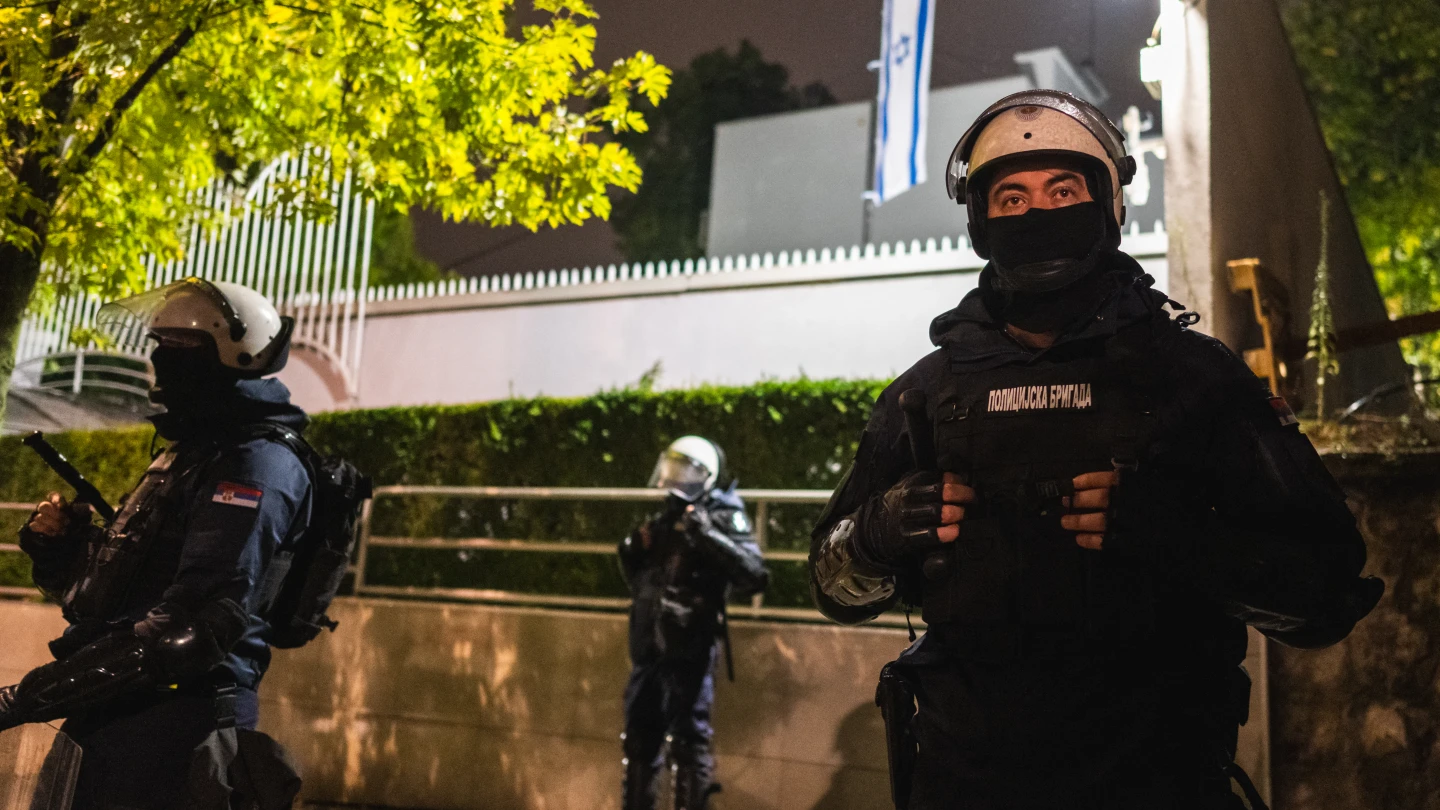
At the Oct. 7 commemoration event, behind a security perimeter with police stationed outside the memorial, Orli Degani, incoming chair of the Jewish Representative Council of Ireland, stated plainly that Irish Jews have become “afraid to say they are Jewish.” In a country that prides itself on solidarity with the vulnerable, Jews now need to take extraordinary precautions to gather together.
While the Irish government has reaffirmed its commitment to combating antisemitism and acknowledged that discrimination against conference participants would be unacceptable, no serving government minister has publicly condemned the actions of the hotel.
The Irish government may not bear responsibility for a private business’s decisions, but it does have a responsibility to respond decisively when credible concerns about discrimination arise.
But statements alone are insufficient. The real test of Ireland’s commitment to countering antisemitism will be measured not by the statements it makes or the meetings it holds, but by the changes it delivers.
What is playing out in Ireland is deeply personal.
Although Irish government officials did not play a prominent role in the conference on antisemitism itself, important conversations took place alongside it. Irish Prime Minister Micheál Martin met with Katharina von Schnurbein, the European Commission’s Coordinator on Combating Antisemitism and Fostering Jewish Life, and Jewish community representatives from several countries. Other senior Irish officials also met with Jewish leaders.
These exchanges deserve recognition.
Through my work with Jewish communities worldwide, I have seen how important it is to maintain open dialogue, particularly when disagreements run deep.
The conversations in Dublin must mark the beginning of a more sustained relationship between the Irish government and Jewish communities, both at home and abroad. The willingness to engage, even amid profound disagreements, matters. But dialogue must be a starting point, not an end in itself.
Ireland already has a National Action Plan Against Racism for 2023-2027, which includes antisemitism. The priority must now be following through on those commitments.
That means adequate resources, clear government accountability, better reporting and investigation of antisemitic incidents and stronger education about antisemitism in schools and universities.
It also means appointing a standalone public envoy with the expertise, authority and resources necessary to understand the specific manifestations of antisemitism and lead a coordinated government response. And it means addressing anti-Jewish prejudice online and in public discourse, while working closely with the Jewish community to assess progress.
This cannot be the responsibility of one ministry or the Jewish community alone. It requires government, law enforcement, educators, civil society and the private sector to act together. Otherwise, Ireland will continue on the road it is currently on: responding to one controversy after another while leaving its Jewish community vulnerable to further discrimination.
The goal cannot simply be to protect Jewish communities from attacks. It must be to ensure they can participate fully and confidently in Irish society, without having to justify who they are.
These stakes extend well beyond Ireland. At a time when Jewish communities across the world are grappling with rising antisemitism, Ireland’s response will offer an important measure of whether governments can move beyond expressions of concern and into meaningful action.
My grandfather spoke with affection about the Ireland that shaped him. I hope today’s Ireland can extend that same generosity of spirit to its Jewish community. Not because Jews must earn their place in Irish society but because they have always been part of it. And because they deserve not merely to remain but to thrive.