


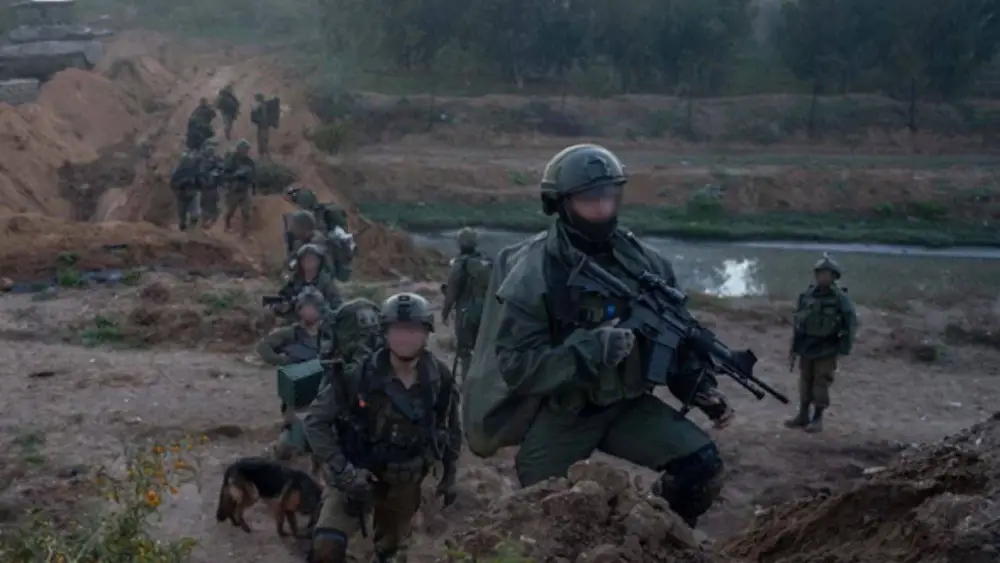

For generations, free societies have depended for their security on a relatively small number of men willing to embrace controlled aggression in defense of others. Civilization is protected not because aggression disappears, but because it is disciplined, directed and placed in the service of a just cause. The very qualities that make a man dangerous to an enemy are often the same qualities that make him indispensable to defending his family, his community and his country.
A recent controversy inside the Israel Defense Forces demonstrates what happens when a society begins to forget that distinction.
On July 30, approximately 100 infantry soldiers from the Tzabar Battalion of Israel’s Givati Brigade walked out of the Sde Teiman military base in southern Israel. They left their weapons behind and departed without authorization after their battalion commander destroyed decorative signs and symbols that the soldiers had erected inside the base.
Videos showed the soldiers marching out together while angrily chanting against their officers. Most later returned after being warned that those who remained absent would be declared absent without leave and referred to the Military Police. The IDF described the walkout as a serious disciplinary incident and announced that those who led it would face punishment.
The soldiers were wrong to abandon their base. A military cannot function when soldiers respond to a dispute with their commander by leaving their weapons and walking out. Discipline is not optional, particularly in a combat unit.
But the misconduct of the soldiers should not prevent us from examining what caused the confrontation.
Among the objects destroyed were signs carrying aggressive imagery and names such as “Kingdom of Devils,” “Satan” and “Angel of Death.” The soldiers described them as part of their company’s heritage and identity. Some soldiers and parents also argued that the area contained flags, memorial items and symbols connected to fallen comrades and earlier generations of fighters.
The battalion commander and the IDF presented a different interpretation. They associated the signs with traditions surrounding the relationship between veteran and younger soldiers and argued that such traditions could contribute to hazing or other inappropriate conduct.
There is an important distinction, however, between preventing actual abuse and erasing aggressive military symbolism.
There have been no public allegations that these soldiers abused anyone, nor that abuse was about to occur. The intervention appears to have been directed at the culture and symbolism themselves. The message was not merely that mistreatment would be punished. The message was that imagery celebrating aggression, danger, hierarchy and warrior identity had become inherently suspect.
That is the deeper controversy.
The event should be understood as part of a wider cultural transformation affecting much of the Western world. Progressive institutions increasingly view traditionally masculine qualities such as aggression, dominance, competitiveness, emotional restraint, toughness and fierce group loyalty primarily as dangers. Instead of asking how these qualities can be disciplined and directed toward protecting society, they seek to soften, suppress or eliminate them.
In many civilian environments, that approach may have merit. A school, university, corporation or government ministry should not operate like an infantry battalion. But an infantry battalion must not operate like a school, university, corporation or government ministry.
The purpose of a combat unit is not to create the most sensitive, emotionally expressive or socially accommodating environment possible. Its purpose is to prepare soldiers to confront organized violence and defeat the people directing it against their nation.
Combat soldiers must be capable of moving toward danger when every natural instinct tells them to run away. They must continue fighting while exhausted, wounded, frightened and surrounded by death. They must be willing to use overwhelming violence when ordered, while remaining disciplined enough to stop when the mission and the law require it.
That combination does not emerge naturally. It must be cultivated. Warrior culture is one of the tools through which armies cultivate it.
An army requires strong men, not softened ones.
Combat soldiers develop aggressive symbols, intimidating names, dark humor, rituals, rivalries, songs and internal traditions. To civilians, some of these may appear crude, excessive or even disturbing. But they perform an essential function. They transform individuals into a cohesive fighting unit. They create a shared identity that connects current soldiers to those who served before them and to those who died wearing the same uniform.
A young infantryman who identifies with names such as “Angel of Death” is not necessarily announcing an intention to commit crimes or harm innocent people. He is expressing a mindset that, when he meets an armed enemy on the battlefield, he intends to prevail. He is embracing the psychological identity required to confront people who are actively trying to kill him and his comrades.
The issue is not whether armies should have standards. They must. The issue is which values those standards are designed to protect. If preserving emotional comfort becomes more important than cultivating combat effectiveness, the institution has lost sight of its purpose. Every decision inside a combat unit should be judged by a single question: Will it make soldiers more capable of winning Israel’s next war?
The removal of a sign may appear insignificant. But symbols express what an institution values and what it fears.
When military leaders become more disturbed by aggressive imagery than by the gradual weakening of martial identity, they reveal confusion about the nature of their own institution. When they treat every intimidating nickname, ritual or display of masculine aggression as a potential social problem, they risk suppressing the very qualities that infantry units require in battle.
The United States is now engaged in the same debate.
Since becoming U.S. Secretary of Defense, Pete Hegseth has made restoring the warrior ethos a central objective of the U.S. military. His emphasis has been on lethality, merit, readiness, high standards and returning the military’s focus to winning wars rather than civilian cultural priorities.
Whether one agrees with every aspect of Hegseth’s agenda is beside the point. He has correctly recognized a fundamental truth: A military exists to fight and win wars. Every policy, every standard, every cultural initiative and every command decision should ultimately be judged by one question: Does this make our fighting force more lethal and more capable of victory?
That is precisely the question the IDF should be asking.
Israel is not protected by geography, distance or peaceful neighbors. It faces enemies who openly glorify violence and devote themselves to Israel’s destruction. They are not concerned that their fighters might become too aggressive. They are trying to make their fighters more committed, more ruthless and more willing to sacrifice themselves.
Israel’s answer cannot be to imitate their brutality or abandon the moral standards that distinguish a democratic army from a terrorist organization. But neither can Israel respond by producing softer soldiers.
The IDF’s historic advantage has always been its ability to combine moral restraint with overwhelming combat aggression. Israeli soldiers are expected to remain moral while confronting immoral enemies. They are expected to protect civilians while destroying those who seek to murder them. They are expected to obey the law while acting decisively enough to survive and win.
That balance requires strong men, not softened ones.
Aggressive men are not inherently a danger to society. Aggression without discipline is dangerous. But aggression shaped by responsibility, loyalty, morality and national purpose is one of the greatest forces a free society possesses. The answer is not to eliminate those qualities. The answer is to direct them toward the defense of the nation.
Israel does not need softer combat units. It needs disciplined warriors, soldiers who are physically relentless, mentally hardened, emotionally resilient and utterly committed to defeating the enemy. We should cultivate units whose identity is built around strength, aggression in battle, sacrifice, brotherhood, heritage and an uncompromising offensive spirit.
The IDF does not exist to produce well-adjusted young professionals. It exists to produce soldiers capable of engaging the enemy, destroying the enemy and bringing victory to the nation.
The soldiers who abandoned Sde Teiman should be held accountable for violating military discipline. But the commanders and the institution must also ask how the situation reached that point.
A military that destroys its warrior symbols while claiming to strengthen its values may be protecting the wrong values. The IDF’s mission is not to reflect the latest social fashions of the civilian world. Its mission is to defend the State of Israel by producing the most capable fighting force possible.
That requires a warrior culture. It requires an army that honors its history, memorializes its fallen, celebrates courage, demands sacrifice, builds fierce unit identity and teaches its combat soldiers that when they meet Israel’s enemies on the battlefield, they must prevail.
The lesson of Oct. 7 was not that the IDF possessed too much warrior culture. It was that Israel can never afford to lose it.


