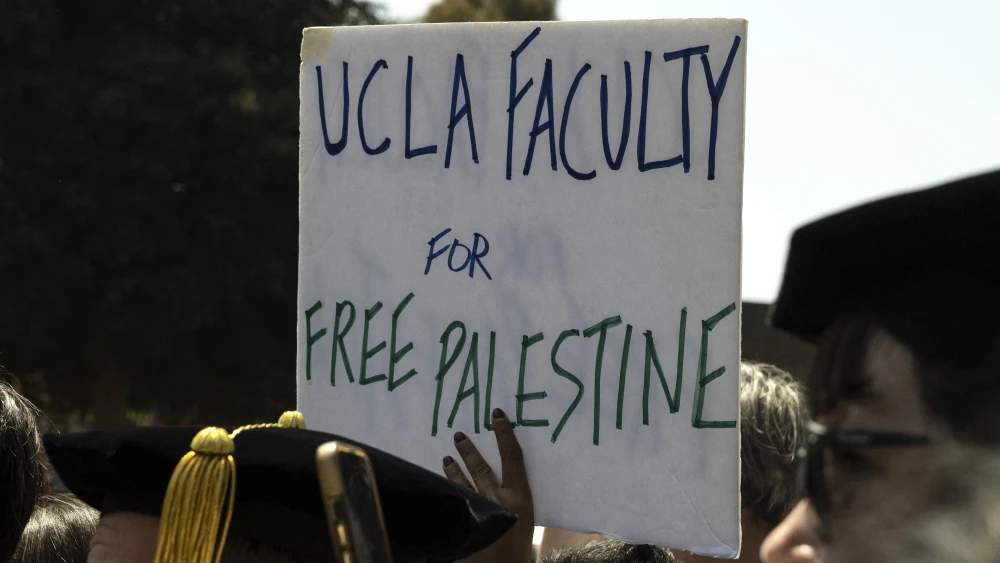

The Anti-Defamation League has just published an alarming report on the role faculty play in campus antisemitism. What is astonishing is not the data. It’s that the report appeared in 2026.
The study notes that “far less scrutiny has been directed toward the role of faculty and the classroom environment” than student activism.
Really?
Here’s what I wrote back in 2004: “The prevalence of outspoken anti-Israel professors is the most insidious danger to Israel’s standing on the campus. Students and advocates come and go, but faculty remain for years and shape the campus environment and the minds of students.”
More than two decades later, that remains true. Student organizations change leaders every year. Protest movements flare up and fade. Faculty, by contrast, can remain on campus for 30 or 40 years. They teach thousands of students, train graduate students who become professors themselves, hire colleagues, determine curricula, control departments and help decide who receives tenure. Their influence is cumulative and institutional.
That is why the faculty problem has always been more consequential than the latest student encampment or protest.
My 2004 report also noted another imbalance that persists today: “Faculty critical of Israel also tend to be extremely vocal and active while pro-Israel faculty usually are reluctant to participate in campus debate.” Even more troubling, I observed that “some anti-Israel faculty in subjects completely unrelated to the Middle East will use their classrooms as forums for propaganda.”
What is now described as a post-Oct. 7 crisis is, in reality, the latest manifestation of a problem that has been festering for decades.
The ADL report does a useful job of documenting it, but its examples should not be mistaken for something new. Consider cases I cited for the Israel on Campus Coalition in 2004:
• The University of California, Berkeley offered a course titled “The Politics and Poetics of Palestinian Resistance.”
• A philosophy professor at Clemson University taught a course called “Living under Occupation.”
• At American University in Washington, D.C., an anthropology professor assigned a comic book reminiscent of Der Stürmer; another professor crossed out “Israel” on a student’s exam and substituted “Zionist entity”; and another distributed maps of the Middle East from which Israel had disappeared.
• A professor in Columbia University’s Department of Middle East and Asian Languages and Cultures lectured that Zionism was a European colonial system based on racist principles whose goal was to eradicate Palestine and that Zionists were the new Nazis.
Nor did faculty activism against Israel begin after Oct. 7, 2023.
My 2004 report noted that 1,500 academics had signed a petition warning that Israel might exploit the “fog” of the Iraq war to commit a crime against humanity by expelling large numbers of Palestinians.
Before there was Faculty for Justice in Palestine, there was Faculty for Israeli-Palestinian Peace, which collected roughly 1,000 academic signatures condemning Israel’s security fence. The organization also sponsored a conference, “An End to Occupation, A Just Peace in Israel-Palestine,” intended to mobilize academia worldwide against the Israeli “occupation.”
The names and organizations have changed. The underlying problem has not.
Academic freedom protects intellectual inquiry; it does not require universities to permit academic malpractice.
Besides being decades late, the most disappointing aspect of the ADL report is that it offers no solutions.
Admittedly, the problem is difficult to address because faculty are largely supervised and judged by other faculty—the proverbial foxes guarding the henhouse. Nevertheless, universities routinely sanction professors for misconduct. Academic freedom has never meant freedom from professional standards.
Theodore W. Ruger, dean of the University of Pennsylvania Law School, put the principle succinctly: “Academic freedom for a tenured scholar is, and always has been, premised on a faculty member remaining fit to perform the minimal requirements of the job.”
That principle should apply to academic malpractice involving Jews and Israel just as it does to every other subject.
The danger is not hypothetical
Universities have several options for disciplining faculty who violate their codes. These typically include written censure, reduction in salary, demotion, suspension, denial or curtailment of emeritus status, and dismissal. Faculty have been disciplined for inappropriate speech and behavior in numerous contexts. What remains rare is comparable accountability when the misconduct involves antisemitism, Israel or the abuse of a classroom to promote pro-Palestinian/anti-Israel propaganda.
Professors Michael Bérubé and Jennifer Ruth have argued that extramural speech generally deserves protection unless it raises legitimate questions about a professor’s fitness for the job. As they explain, a historian who denies the Holocaust is plainly professionally unfit, while an electrical engineer who denies it may simply be a crank.
The paradox, they note, is that professors can therefore enjoy greater protection when speaking irresponsibly about subjects they know nothing about than when making demonstrably false claims within their own areas of expertise. This is often the case, for example, when departments unrelated to the Middle East issue statements critical of Israel.
More important, Bérubé and Ruth distinguish legitimate political disagreement from outright falsehood. The latter, they argue, can be “qualitatively different—and disqualifying.”
Academic freedom should not protect falsification, discrimination, intimidation of students or the conversion of a classroom into a platform for political indoctrination unrelated to the course.
Universities can also reduce the likelihood of future scandals by taking greater care in hiring and promotion. A candidate with a history of antisemitic remarks may be free to hold those views but is not entitled to employment or advancement. Universities would not hire overt racists and should be equally unwilling to employ antisemites.
Faculty members may restrain themselves before receiving tenure and then treat tenure as a grant of immunity. It should not be. Universities should also stop pretending that publicly available evidence about a candidate’s judgment, scholarship and behavior is irrelevant to determining that person’s fitness to teach students and represent the institution.
The principle should be simple: Academic freedom protects intellectual inquiry; it does not require universities to permit academic malpractice.
My 2004 report proposed a strategy for changing the academic environment: endowing chairs in Israel Studies; creating Israel Studies centers; training a new generation of Israel scholars; bringing visiting Israeli professors to American campuses; and improving teacher training in Israel Studies.
My nonprofit, the American-Israeli Cooperative Enterprise (AICE), subsequently put those ideas into practice.
From 2006 to 2015, AICE brought more than 100 visiting Israeli scholars to more than 50 American campuses, including many of the nation’s elite universities. The objective was not to manufacture pro-Israel propagandists. It was to ensure that students could study Israel in all its complexity instead of encountering it solely through the prism of the Arab-Israeli conflict and the ideological preoccupations of Israel’s critics.
The project pursued several goals:
- Dramatically increase the number of courses about Israel. At the time, many campuses offered few, if any, courses devoted to Israel. Our visiting scholars introduced 145 new courses and taught more than 9,000 students.
- Broaden the academic study of Israel. We brought together scholars from 23 disciplines, including musicology, psychology, film, literature and education, demonstrating that Israel is a complex society worthy of studying like any other country.
- Bring outstanding Israeli scholars directly to American students and communities. Our visiting professors lectured publicly, met students informally, organized dinners and holiday gatherings, advised student organizations, helped students evaluate anti-Israel arguments, wrote recommendations and directed students toward scholarships, Hebrew study and opportunities in Israel.
- Create permanent academic infrastructure. At least 14 new chairs, centers and visiting-scholar programs were established as a direct or indirect result of the AICE initiative.
- Build the next generation of Israeli scholars. We supported 20 postdoctoral fellows who conducted research and taught at elite universities and awarded financial support to 40 graduate students, many of whom went on to positions at leading institutions. One problem they encountered is that the entrenched anti-Israel faculty made it difficult for some to find positions.
AICE lost its funding, and the program ended—and much of the momentum for Israel Studies did, too. Apart from a new program at Stanford University announced last year, I am unaware of a new Israel Studies chair or program created in nearly a decade. The number of courses does not appear to have grown significantly, and since Oct. 7, even some scholars in Israel Studies have joined the chorus of Israel’s harshest critics.
Our experience also taught us that even well-meaning efforts can backfire.
From the beginning, we warned donors about simply writing large endowment checks to universities for Israel Studies positions without safeguards to ensure that their philanthropy did not ultimately finance the very ideological agenda they hoped to counter.
That danger was not hypothetical. It happened at Berkeley and Columbia.
Berkeley subsequently reversed course and today has what is probably the strongest Israel Studies program in the country—one created with the help of an AICE visiting scholar.
I was also involved in establishing the Israel Studies chair at UCLA. Its first occupant was an Israeli and an excellent scholar. When he left, he was replaced by a professor who signed a statement accusing Israel of “ethnic cleansing” and “apartheid,” an example of the risk that donors take when they endow a position but have no say over how it evolves after the original appointment.
One of the graduate students our program supported also proved a disappointment. Now a professor at the University of Washington, she signed the same statement and criticized donors supporting Israel Studies, including one who helped fund her doctorate. The donor supporting her chair withdrew the funding—an option that is not always available once an endowment has been created.
The lesson is that donors need to pay attention to governance, hiring procedures, academic standards and the long-term disposition of their money. Writing the check is the beginning of the responsibility, not the end.
An uneven playing field
There is also a fundamental asymmetry in academia today.
Many pro-Palestinian faculty regard activism as part of their academic mission. They sign petitions, organize demonstrations, advise activist groups and turn their classrooms into extensions of their politics. By contrast, Israel Studies professors are hypersensitive to even a whiff of advocacy in their scholarship or teaching.
This creates an uneven playing field.
We don’t need faculty to be advocates in the classroom. If professors present the evidence, provide historical context, expose students to competing interpretations and correct the myths propagated by colleagues, activists and the media, they will have accomplished their academic mission.
Where they should be advocates, however, is in supporting Jewish students, speaking out against antisemitism on campus, and calling out their colleagues for academic malpractice.
The events since Oct. 7 did not create the faculty problem. They exposed the cost of decades of failure to confront it.