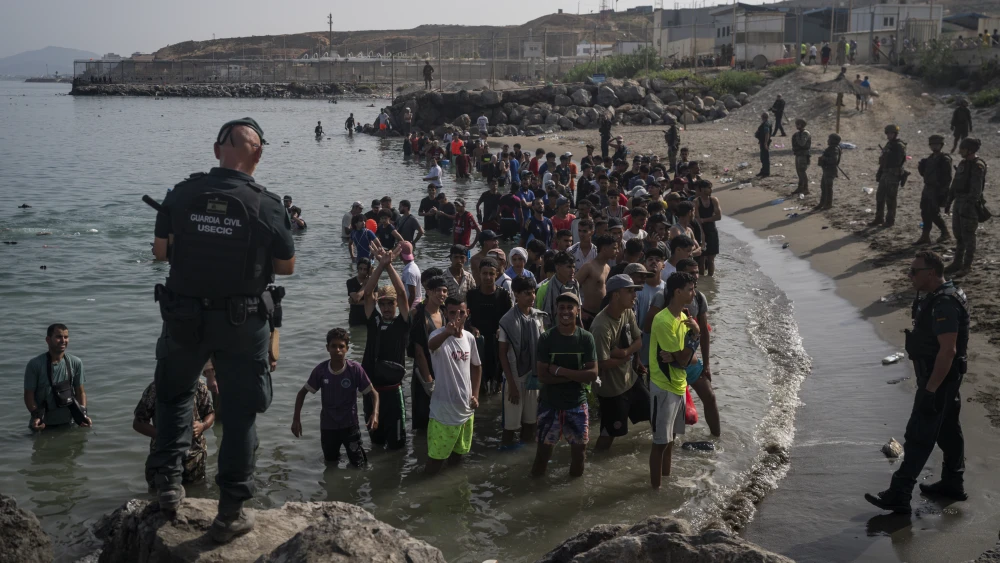

As many as 60,000 illegal immigrants crossed into the Spanish city of Ceuta, on the northern coast of Africa, in 24 hours on July 30. Most returned to Morocco within two days, but more than 70 people died in the chaos. Spanish Prime Minister Pedro Sánchez called the events a violation of territorial integrity.
During the crisis, Danny Danon, Israel’s ambassador to the United Nations, stated: “Spain, which never misses an opportunity to lecture Israel, has declared a state of emergency in Ceuta following the crisis over its immigration policy. Maybe before it continues lecturing us, it’s time it explained to the world why it still maintains colonial enclaves in Africa.”
He launched an unnecessary attack on Spanish territorial integrity and sovereignty over Ceuta and nearby Melilla. Shortly after, two prominent politicians from Spain’s right-wing Partido Popular (PP) and VOX parties pushed back sharply. If this rift is not mended—and at the highest level—Israel risks wasting a rare chance to see one of Europe’s most important countries transform from a hostile actor into an ally after the 2027 elections.
Reactions from the political right
The response to Danon’s statement from politicians associated with PP and VOX was immediate. As reported on Aug. 1 by Estrella Digital, Pedro Muñoz Abrines, a PP deputy, wrote: “I will tell you very clearly. I am a friend of Israel, but his statement is a sovereign stupidity.”
The same report quoted Jorge Buxadé, a senior VOX member of the European Parliament, saying, “Ceuta and Melilla are not ‘colonial enclaves,’ but an integral part of the Spanish nation for centuries.”
The top leaders of both parties—Alberto Núñez Feijóo and Santiago Abascal—have so far confined themselves to criticizing Sánchez’s handling of the crisis. Nonetheless, the reactions from Muñoz Abrines and Buxadé remain meaningful signals of discontent among natural allies.
Both reactions came after Israel’s representative in Madrid, Dana Erlich, publicly stated on July 31 that Danon’s comments “do not represent the position of the State of Israel.”
Buxadé replied later that morning and PP deputy Muñoz Abrines the following morning. That these figures still pushed back after the embassy’s official distancing shows that Erlich’s clarification, while necessary, was not enough on its own.
The fact that party leaders didn’t react shouldn’t be read as a sign that this is a minor dispute: The senior politicians in both parties likely spoke out to avoid escalating to statements by the leadership, who may prefer to avoid a formal rift with Jerusalem. However, the signal is no less real for being deniable, and it reveals something deeper than ordinary diplomatic friction; it shows where the comments landed hardest and why.
For Spain’s political right, territorial sovereignty—and the status of Ceuta and Melilla—are core identity issues, even more sensitive than they are for the left. These cities have been Spanish for centuries and are fully integrated autonomous cities with Spanish citizens. Questioning that status is similar to challenges to Jewish sovereignty in eastern Jerusalem and Judea and Samaria for many Israelis. It causes anger and offense, as these places are not mere land; they are part of an identity and a history. To be clear, this is not a claim of legal or historical equivalence between the two cases, but solely to help readers understand how Danon’s comments were taken in Spain.
The strategic stakes
Spain is a major European Union and NATO member. Recent Spanish polling (Sigma Dos, Sociométrica, InvyMark and others in July 2026) consistently shows PP leading in the next election, with VOX holding a significant share of the vote in the mid-to-high teens. A PP or PP-VOX government after the 2027 elections is a real possibility and could produce a shift as dramatic as the recent positive flips Israel has seen in Slovenia and Colombia.
Israel cannot afford to burn bridges with the two parties that would make that shift possible. These are natural allies whose voters feel a double sting when Israel attacks Spanish sovereignty: It’s not only an affront to their country but comes from a government that they support and defend at a time when doing so isn’t always popular.
Discontent with the Sánchez government’s record on Israel is entirely warranted. The problem is that Danon’s comments did not target governmental policies and instead targeted Spanish sovereignty over Spanish cities. This is self-inflicted damage that could hurt Israel for a long time to come.
The gap between Madrid’s current government and its likely successor is stark. On Gaza, Sánchez’s Partido Socialista Obrero Español (PSOE) has repeatedly called Israel’s military campaign a “genocide,” while PP and VOX defend Israel’s right to self-defense and reject that label. PSOE recognized a Palestinian state in 2024, while PP opposed the move as empowering Hamas, and VOX has vowed to reverse it outright. PSOE also imposed an arms embargo, a port ban on fuel shipments to Israeli forces and a settlement-product boycott—steps PP and VOX opposed.
A government led by PP, with or without VOX, would reverse or significantly soften most of these anti-Israel measures and treat Israel as an ally, rather than a near-adversary.
To heal this self-destructive rift, Israeli Foreign Minister Gideon Sa’ar and, if necessary, Israeli Prime Minister Benjamin Netanyahu himself should conduct private outreach to PP and VOX’s leaders. The message must be unambiguous: Israel fully respects Spanish sovereignty over Ceuta and Melilla; Danon’s comments do not reflect Israeli policy; and Israel’s disagreements are with the policies of the current Spanish government, not with Spain as a country or its people. A clear public statement from the same level should follow.
Israeli decision-makers should also consider whether a stronger step is needed.
Danon has served the State of Israel and the ruling Likud Party for decades, compiling a record that deserves credit; however, his statement was a serious diplomatic and political blunder. A veteran diplomat should have anticipated its ramifications for Israel’s relations with an important European country. If senior leadership determines a stronger signal is needed to restore confidence with Spain’s political right, removing him from his U.N. post, while honoring his past service and leaving open future domestic roles, would be a proportionate decision in Israel’s long-term interest.
Israel has every right to criticize the Sánchez government for its anti-Israel policies. It does not serve Israel’s interests to turn that criticism into an attack on Spanish sovereignty and alienate the very parties who have stood by Israel when doing so is not easy. With a realistic path to a more pro-Israel Spanish government in 2027, Israel should act swiftly to protect a strategically valuable relationship that can still be salvaged. The opportunity is real, and the cost of wasting it would be felt for years.