


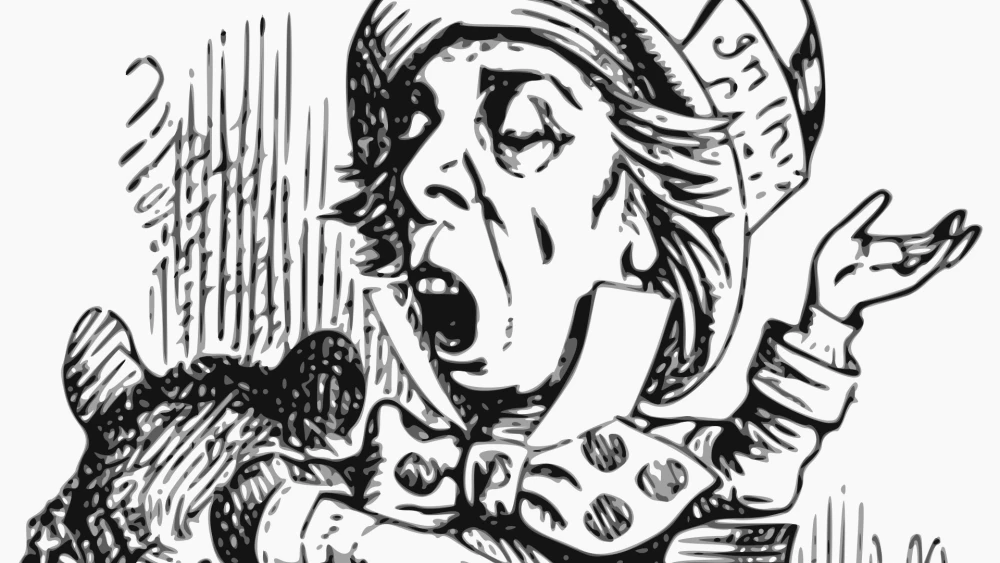

“But I don’t want to go among mad people,” Alice remarked.
“Oh, you can’t help that,” said the Cat: “We’re all mad here. I’m mad. You’re mad.”
“How do you know I’m mad?” said Alice.
“You must be,” said the Cat, “or you wouldn’t have come here.”
— Lewis Carroll, Alice in Wonderland, Chapter VI
The sentiments being expressed by contemporary anti-Zionists, non-Jews as well as Jews, coupled with the logic of their arguments, asserted information upon which their opinions are based, manipulation of their publicity campaigns and their violent, aggressive behavior are not only frightening in their irrationality and paucity of facts, but uncontestably point to a darker option: They are mad.
They are mad in a psychotic sense and angry emotionally. They are entrenched in their worldviews and have lost the fundamental ability to judge themselves, their actions and their values. Moreover, they refuse to permit themselves to be challenged or confronted with counter-information.
Jews have been returning to the land of Israel for more than 3,000 years. They are a people whose national characteristic includes a constant process of repatriation to a homeland, forced or desired. From out of Egypt to where the forefathers lived and out of Babylon to where Jews were exiled, and since the destruction of the Second Temple in Jerusalem, it’s been an ongoing ascent over centuries from every single land of Jewish dispersion.
Rabbis and Torah scholars repatriated themselves, as did retirees and simple folk. Jews the world over contributed charitable funds for the livelihood of Jews living in the land, to support educational and community institutions, to sponsor the purchase of property and even to assist Jewish economic development. Religious or secular, poetry or prayer, literature was the product of the land of Israel, whether in Safed or Gaza, from the psalms of David to the Zohar of Yitzchak Luria.
It’s simply mad to ignore all this.
Jews moving to and residing in the Land of Israel was not a European, 19th-century copycat colonialization scheme. It was and continues to be Judaism in practice. It is a mitzvah, a religiously motivated positive deed. Jews desired to live in Jerusalem and be buried there. They looked to the land of Israel not only when they prayed in that direction, but also for spiritual uplift and intellectual increment. Jews saw invaders and conquerors, empires and occupiers come and go, but they remained a constant demographic factor of the country.
Israel, with its heartland of Judea and Samaria, became Judaea. Judaea became Palaestina. Palaestina became Jund Filastin, and Bilad al-Sham and then Sūriyā al-Janūbiyya, or Southern Syria. The land switched rulers but never lost its identity as being sacred—the land of the Jews. It is the soil from which tithes were taken, where only certain blessings and agricultural customs were done, where the shmita year was practiced, and where the Temple service was performed.
Remove all this, even from Jewish history, and one eliminates the Jew and his Judaism. The Jew’s individuality and experience are erased. To borrow a current term, a genocide is thus being practiced on Jewish distinctiveness, on his or her identity, on the very existence of the Jews and Judaism. We Jews are being subjected to “civilizational erasure.”
Madness has surely set in. Madness has overcome all rational thinking. Not that it is currently on the agenda, but a two-state solution has been attempted over and over again, and has failed continuously. It has never been accepted by Arabs—not in 1921 when TransJordan was created for a Saudi Arabian refugee; not in 1937 or 1947; or in any other formulation, from Camp David’s autonomy to Oslo’s self-governance. Instead of being mad about a two-state solution, why not devote efforts to resolve the rejectionism at the root of the Arab opposition?
After 106 years of Arab-initiated murderous violence—riots, pogroms, terror and war—beginning, for argument’s sake, in April 1920, why would continuing to allow enemies to maintain armed units and practice anti-Jewish incitement, and thus permit them the capacity to kill, plunder, burn and rape, not be considered madness if not acting in a suicidal fashion?
On the up-to-date political front, there is the example of New York City Mayor Zohran Mamdani’s madness, pushing the anti-Israel antisemitic trope of “dark money” and purposefully promoting anti-Israel conspiracy theories such as “merging” the U.S. and Israeli militaries through a U.S. defense bill.
Franklin Foer, writing in The Atlantic on his version of “How Netanyahu Lost America,” points his accusatory finger at Israel’s prime minister: Benjamin Netanyahu himself. It is he who has “shattered his country’s standing.” Foer cannot, it seems, absorb the shock waves of Jew-hatred, of the woke and progressive takeover of academia, of neo-Marxist instruction and its textbooks in and out of schools, both primary and higher. He cannot fathom the left/Islamist alliance for he is mad for liberalism and moral ethics.
More madness can be found in a July 28 piece that columnist Bret Stephens wrote for The New York Times. While he thinks it “fair” to assume that antisemitism affects the double standard judgment of Israel, nevertheless, “hatred isn’t what has caused formerly supportive Democrats to view Israel as a political liability.”
Part of the problem, à la Stephens, is “settler violence.” And Netanyahu bears guilt because “he would prefer not to [end that problem].” Yet the issue is reversed. Settlers would prefer to live in peace. Violence—murder, rape, setting fires, throwing stones and firebombs—has served the Arabs-cum-Palestinians well. The world has decided their cause is just. All Stephens needs to do is read his own newspaper to see that.
Yet if I may suggest a thought to Stephens: It isn’t a hatred of Jews that is a major cause of the weakening of politicians, formerly loyal to Israel, to lose their nerve. Rather, it’s fear. It is the fear of rising Islamism and of losing elections. It is the fear of losing public standing and stature among a swath of voters gone mad.
And, of course, it is also a fear of physical harm. Evidence for this is Rep. Jared Moskowitz (D-Fla.), who indicated that antisemitic threats directed at him made him fear for the safety of his family. Or non-Jewish Rep. Adam Smith (D-Wash.), saying anti-Israel activists had vandalized his home, harassed his family and assaulted a staff member because he wanted to support U.S. military aid to Israel (in the end, he did not in a recent congressional vote). He calls it a “toll.” Or Rep. Ritchie Torres (D-N.Y.), who is also not Jewish, acknowledging that his strong support for Israel has resulted in relentless abuse that also affects family members.
In his 1608 play, “A Mad World, My Masters,” Thomas Middleton penned a line in which he called physicians “mad gentlemen.” And why? They “look downward into the body, and … have power upward and downward.”
Today’s world of anti-Zionism is a mad one, with one difference: No one is looking up or down, but staring straight at the Jews and wishing them ill, wishing upon them evil and extreme misfortune.



