
In the elections for the 13th Knesset in 1992, there was a feeling on the Israeli right that the Likud Party needed shoring up and there were surely more than enough voters who agreed with this view. To a certain extent, this was correct. Almost.
The official results showed that the Likud received 651,229 votes, Raful Eitan’s Tzomet Party received 166,366 votes, Rehavam Ze’evi 62,269 votes, and the three religious parties—NRP, Shas and Aguda—got 345,077 votes combined.
Four additional right-wing parties, three of which were making new appearances, together received 65,185 votes. However, as none of them passed the minimum threshold of 39,253 votes, not one achieved Knesset representation. Among them was the Techiya party, which had been in government but missed out by some 8,000 votes.
Tzomet ran with Techiya before Eitan split off. Ze’evi of Moledet, despite discussions, declined to run together with Techiya. Rabbi Moshe Levinger and Rabbi Moshe Mizrachi thought they had enough charisma and justification to siphon off votes. They didn’t, and neither did Yitzchak Moda’i, who had set up the New Liberal Party.
All this provided Yitzhak Rabin’s Labor Party (906,810) with the coalition leverage to form a government with Shulamit Aloni’s Meretz (250,667) and the right-leaning Shas party led by Aryeh Deri (129,347). Fifteen months later, the Oslo Accords were signed.
Three decades have passed, and it seems that history is repeating itself. The parties of the right are apparently repeating their 1992 maneuver: split, remain divided and lose.
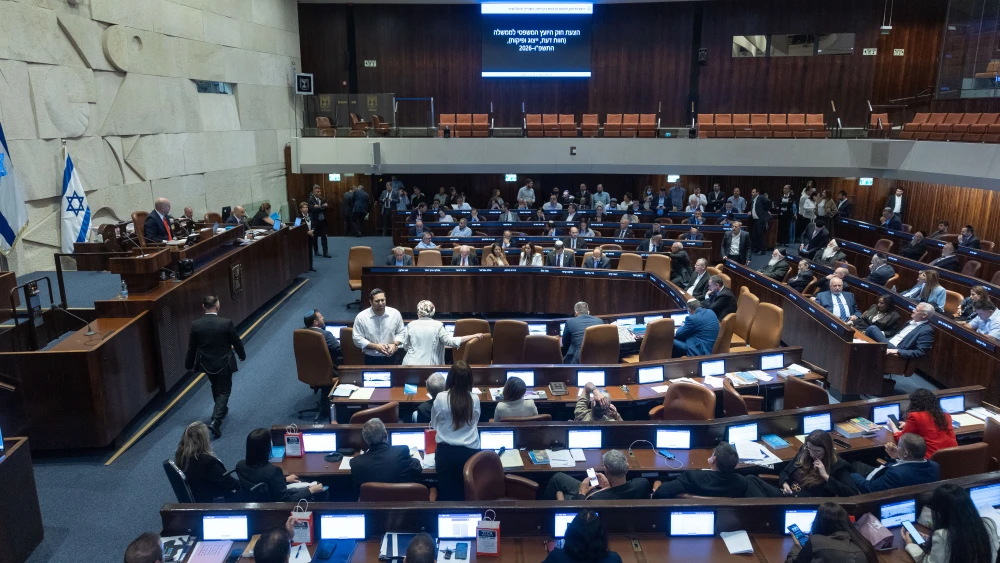
Israelis will cast their votes on Oct. 27. If the turnout is the same as 2022, which was 70.63%, the baseline vote for this year would be around 5.181 million voters. With a 3.25% Knesset threshold, the cutoff for participation in coalition negotiations would be a minimum of 168,350 votes. There will be many lost votes.
Currently, aside from the Likud, there are Otzma Yehudit led by Itamar Ben-Gvir and Bezalel Smotrich’s Religious Zionism party. The latter appears to be just crossing the Knesset threshold. If we also consider soft-core centrist-right lists, however, the line to get in is becoming increasingly difficult to cross.
Moreover, there are fewer than eight seats in play. Former Israeli Prime Minister Naftali Bennett is still seeking to pose as semi-right, even though his rhetoric is more directed at the centrist camp. Yoaz Hendel and Hili Tropper, who left Benny Gantz’s Blue and White Party, have founded the Zionist Home‒The Reservists. Former Knesset member Einat Wilf is also running as a centrist leaning slightly right.
Former Likud members Yuli Edelstein and Gilad Ardan are planning a run. Former Justice Minister Ayelet Shaked and former Israel Defense Forces Gen. Ofer Winter are looking for a landing place. Benny Gantz is still in the running, as of this writing, as are Moshe Feiglin and his Zehut list.
As in horse racing, a crowded field can result in a nasty collision. Those driven by an “anyone but Bibi” ethos could be heading toward disaster.
Israeli Prime Minister Benjamin Netanyahu’s demand from Likud institutions to allow outside candidates to fill reserved slots on the party list—eight out of the first 25—reveals his awareness of the precarious state of the Israeli right-wing. Netanyahu’s move caused problems within Likud before the party’s primaries, and now, with the results, the unrest continues. No one likes being pushed down the list after you earned your spot the hard way.
Nevertheless, his Likud critics should realize that the party’s survival should be the priority and they should focus on achieving a governing coalition.
Not everything is going wrong on the right. Unfortunately, that is not because the right is being smart, clever or appropriate. For example, on the issue of Haredi military service, possible incarceration and/or monetary punishments, the right does not appear to be proposing a workable solution.
However, there is Netanyahu’s long-standing ace-in-the-hole: media interference and bias. For example, Joshua Leifer, whose roots lie in the non-Zionist publication Jewish Currents, wrote in Haaretz on July 31 on Gadi Eisenkot’s published electoral platform, suggesting that Eisenkot’s pledge to “pursue peace” is “striking.”
Why? Leifer wishes us to believe that the word “peace” has been “banished from popular discourse for more than a decade.”
Of course, it wasn’t. I checked the Likud’s 2022 platform and found that the word was used around a dozen times.
The media’s anti-Netanyahu stance is a staple, and the hullabaloo over a Likud poster highlighting New York City Mayor Zohran Mamdani along with other baddies is another example.
Two months are left to election day. All the candidates and all the parties are more than likely to make mistakes and get things wrong. Will the voters get it right?