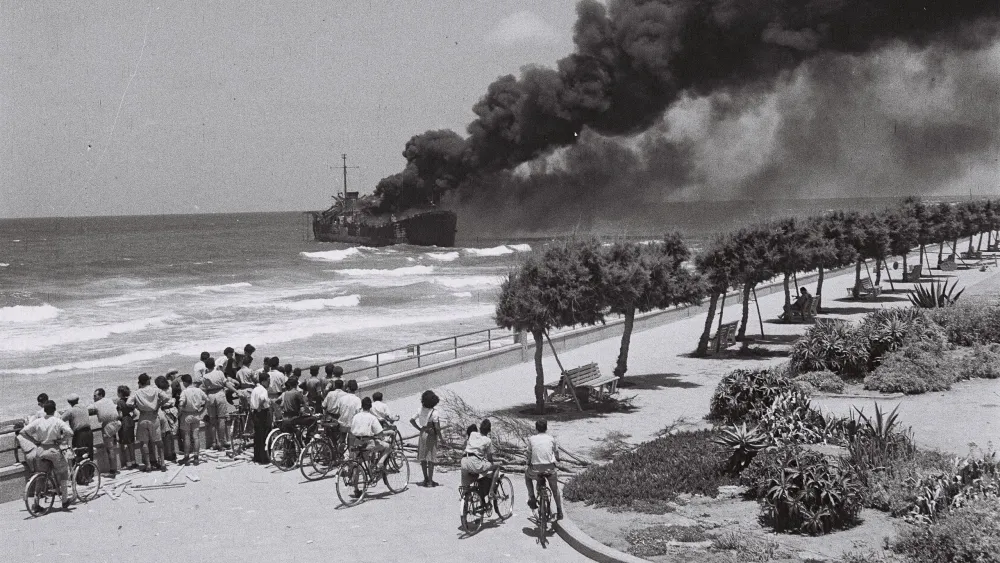

Seventy-eight years after it was sunk in June 1948, the vessel Altalena has been located at a depth of 503 meters off Israel’s Mediterranean coast, apparently intact. The discovery has returned one of the most contested episodes of Israel’s founding to public debate, but its importance lies in more than the recovery of a historical wreck. It offers an opportunity to reconsider not only what happened in 1948, but how one interpretation became embedded in Israeli collective memory, and how the power to define the past can shape the political categories through which a society understands its present.
Most Israelis were raised on a relatively straightforward account: The State of Israel had just been established, the Israeli Defense Forces had been created, and Zionist leader David Ben-Gurion faced the task of establishing a single sovereign authority. The paramilitary Irgun, under the command of Menachem Begin, brought a ship carrying immigrants and weapons to Israel; a confrontation developed over those weapons; and Ben-Gurion acted to establish the principle of one state and one army. The shelling of the Altalena consequently became part of the founding story of Israeli democracy; the moment when legitimate state authority prevailed over an armed faction supposedly unwilling to accept it.
No sovereign state can tolerate competing armies. But that principle does not settle the historical question, because by the time the Altalena arrived, the Irgun had already agreed to dissolve as an independent organization and integrate into the IDF. The dispute concerned the weapons, including arms intended for Irgun forces in Jerusalem, whose status was then distinct, and Begin’s demand that some be allocated to former Irgun battalions already incorporated into the IDF.
As the confrontation escalated, Begin repeatedly instructed his men not to retaliate against fellow Jews, including after the ship came under artillery fire. Sixteen Irgun members and three IDF soldiers were killed. Ben-Gurion would later describe the cannon used against the ship as the “holy cannon.”
These facts neither transform Ben-Gurion into a villain nor vindicate every Irgun decision, but they make the neat moral division inherited by generations of Israelis considerably harder to sustain. It is that division, perhaps more than the events themselves, that constitutes the enduring legacy of the Altalena.
The side that prevailed in 1948 did not merely possess the authority of government.
In the decades that followed, Ben-Gurion’s Mapai—later the Labor Party—and the political establishment surrounding it exercised enormous influence over the institutions through which Israelis encountered their history, including education, academia, media and culture. Political victory meant considerable power to determine the language through which the state’s formative struggles were understood.
The Altalena became part of a larger political vocabulary. One camp came to be associated with mamlachtiyut: institutional responsibility and the defense of democracy. The other carried associations of factionalism, extremism and danger to the state. What began as an argument over one confrontation contributed to assumptions about who naturally represented legitimate state authority and who had to prove that opposition to those wielding it did not constitute opposition to the state itself.
This matters because democracy is a system in which political legitimacy belongs to the public, and governments change according to the choices of citizens. When one political tradition becomes culturally identified with democracy itself, electoral defeat can be experienced not as the legitimate transfer of power to an opposing camp, but as democracy losing power to forces perceived as threatening it.
This helps explain a recurring feature of Israeli political discourse: Political movements that repeatedly win elections can nevertheless find themselves described as dangers to democracy, while institutions without a direct electoral mandate can be presented as democracy’s principal defenders. Opposition to particular institutions can consequently be interpreted not simply as disagreement over their constitutional role, but as hostility toward democracy itself.
Democratic institutions are essential precisely because political power requires limits, but no institution or political camp can claim democracy as its exclusive domain. The problem begins when one political camp, or the institutional culture historically associated with it, acquires an implicit proprietary claim over democracy, so that its own exercise of power is presumed to defend the democratic order while the democratic power exercised by its opponents is treated with inherent suspicion.
Seen in this light, the Altalena illustrates how political power becomes narrative power, narrative power becomes institutional memory, and institutional memory eventually shapes the boundaries of political legitimacy.
Historian Shlomo Nakdimon’s extensive research into the Altalena affair documents a historical record considerably more complicated than the simplified political narrative that developed around it. Revisiting that record doesn’t require replacing one partisan history with another, but recognizing the consequences that can flow from the difference between an event and the story told about it.
The discovery of the Altalena allows Israel to revisit that inheritance, separating the historical event from the narrative built around it and examining how that narrative continues to shape our assumptions about who represents the state, whose authority is considered legitimate and whose is instinctively regarded with suspicion. Nearly eight decades later, the consequences of that distinction remain one of the deepest fault lines in Israeli democracy.