
The Malabar Coast of southwestern India has long been one of the world’s most dynamic maritime crossroads, a region where merchants, monarchs and migrants shaped cultures through commerce and exchange. Pepper, cardamom, ivory and textiles moved through its ports, linking Kerala to Arabia, Persia, East Africa and the Mediterranean. Jewish merchants were part of this Indian Ocean world, arriving not as isolated settlers but as participants in a cosmopolitan commercial network that connected distant cultures through shared economic interests.
Early Jewish settlements flourished in Cranganore, known in classical literature as Muziris, before floods, conflict with the Moors, and later Portuguese aggression pushed the community southward to Cochin (Kochi) in the state of Kerala, India.
Cochin offered stability, royal patronage and access to thriving maritime commerce. It became the new center of Jewish life in Kerala, a place where local traditions and global connections shaped a distinctive civilizational identity.
Kerala’s layered historical landscape blends oral memory, temple records and royal chronicles, leaving scholars to navigate a terrain where dates are contested and evidence must be weighed carefully. Claims of Jewish arrival range from the era of King Solomon to the first century C.E., yet the community’s documented presence rests on a remarkable royal charter inscribed on copper plates around 1,000 C.E.
The Malabar Coast of southwestern India shaped the development of Jewish life in Kerala through its role as one of the most active commercial corridors of the medieval world.
It is a story of recognition, resilience and rootedness, preserved in metal and carried through memory.
Merchants from Arabia, Persia and East Africa converged on its ports, creating a cosmopolitan environment in which Jewish traders found opportunity and protection. The community’s movement from Cranganore to Cochin reflected both environmental change and shifting political alliances. Under the protection of local rulers, Jewish merchants rebuilt their institutions and integrated into Kerala’s cultural fabric while maintaining distinct traditions that connected them to the wider Indian Ocean world.
Kerala’s tradition of granting formal privileges to merchant communities is also seen in the ninth‑century Kollam Copper Plates, which recognized the rights of Syrian Christian traders. The Cochin Copper Plates continue this pattern, extending similar royal protections to the Jewish community. Alongside the Cairo Genizah and the Paradesi Synagogue, they form a triad of sources that allow historians to reconstruct a civilizational narrative. These documents reveal a community shaped by commerce, diplomacy and cultural integration within one of the most dynamic maritime regions of the medieval world.
The Paradesi Synagogue
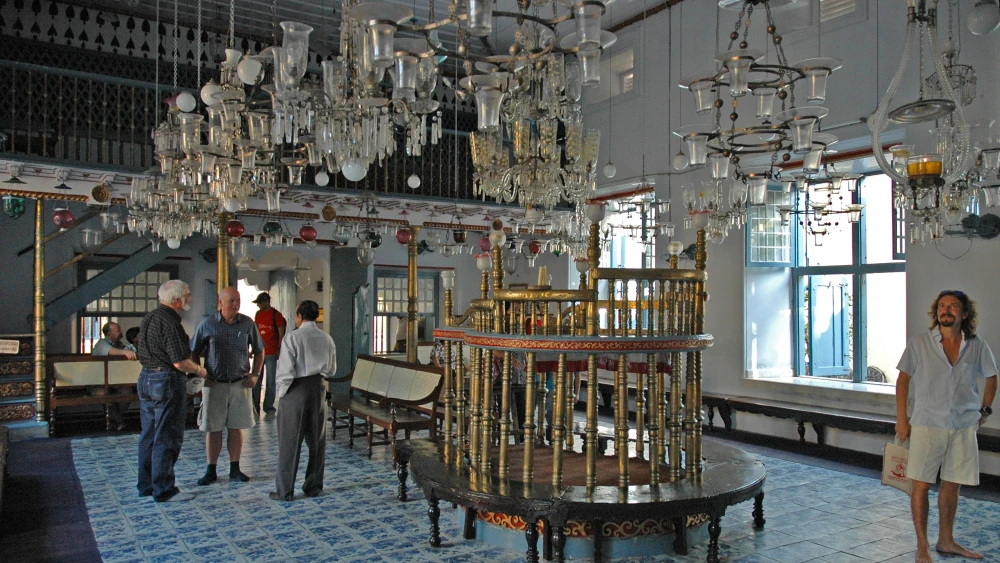
The most visible symbol of Cochin Jewish identity is the Paradesi Synagogue, built in 1568 by four Jewish families who secured land adjacent to the palace of the Raja of Travancore. The synagogue was destroyed by the Portuguese in 1662, though rebuilt the following year under Dutch protection, reflecting the turbulent geopolitics of the era.
Its reconstruction signaled both resilience and the value placed on the Jewish community by local rulers.
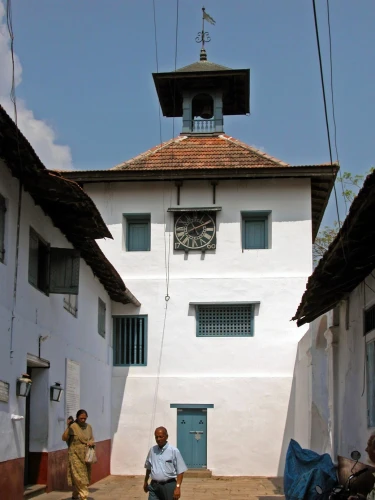
The synagogue’s architecture, with its blue-and-white tiles, brass lamps and hand-painted clock tower, reflects a blend of Kerala, Jewish and European influences.
In 1968, the synagogue celebrated its 400th anniversary, inaugurated by then-Prime Minister Indira Gandhi and honored with a commemorative postage stamp. Although it no longer serves as an active house of worship, it endures as a meticulously preserved monument.
The synagogue stands today as one of the oldest preserved synagogues in the world and the oldest in India, embodying the cultural and historical legacy of the Jews of Cochin. It remains a physical link to a community that once flourished on the Malabar Coast and a testament to the endurance of memory across centuries.
The Copper Plates
If the synagogue is the visible symbol of Cochin Jewish history, the Copper Plates are its constitutional foundation. Inscribed around 1,000 C.E. during the reign of Bhaskara Ravi Varman, they grant the Jewish leader Joseph Rabban extraordinary privileges. Written in Vatteluttu script with Grantha characters, the plates reflect the linguistic diversity and administrative sophistication of medieval Kerala. Preserved in a ceremonial chest known as the pandal, they served as both a legal document and a sacred communal possession.
Often called the Magna Carta of the Jews of Cochin, the plates establish legal autonomy, commercial rights and aristocratic status for the community. They present Rabban as the recognized leader of the Anjuvannam merchant guild, granting him authority within one of Kerala’s most influential commercial institutions. The plates confer exemption from payments required of other settlers and affirm rights equal to and exceeding those of other communities. Their privileges were hereditary, ensuring that Rabban’s descendants would inherit both status and responsibility.
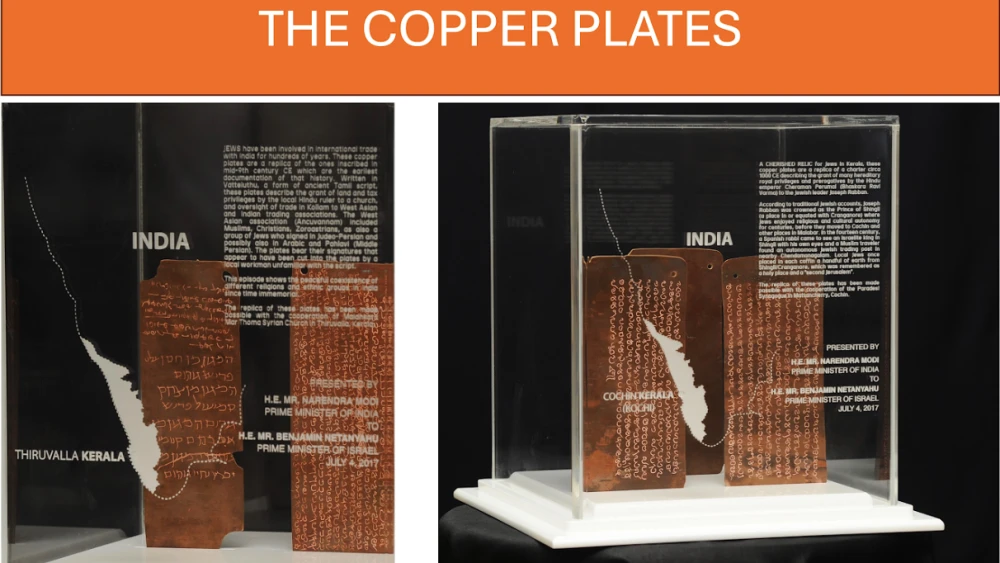
The Copper Plates have continued to surface in moments of modern diplomacy: The Cochin Jewish community presented a replica to Israeli Prime Minister Ariel Sharon in 2003, and in 2017, India’s Prime Minister Narendra Modi gifted Israeli Prime Minister Benjamin Netanyahu a new set crafted with the Paradesi Synagogue. (I also hold a replica set, a reminder of how this thousand‑year charter still travels across continents as a symbol of continuity.)
Although Rabban is presented in the Copper Plates as the hereditary leader of the Jewish merchant guild, scholars debate whether he was a single historical figure, a dynastic title or a symbolic representative of a multi‑ethnic trading community.
Rabban emerges as a merchant leader whose influence extended across the Indian Ocean world. His leadership of the Anjuvannam guild placed him at the center of Kerala’s maritime economy. The Seventy Two Privileges listed in the plates included symbols of aristocratic rank such as the palanquin, umbrella, day lamp, decorative cloth, kettledrum, trumpet and the authority to build gateways and arches. These privileges were not ornamental; they signaled integration into Kerala’s political order and affirmed the community’s recognized place within the region’s hierarchy.
The Cairo Genizah
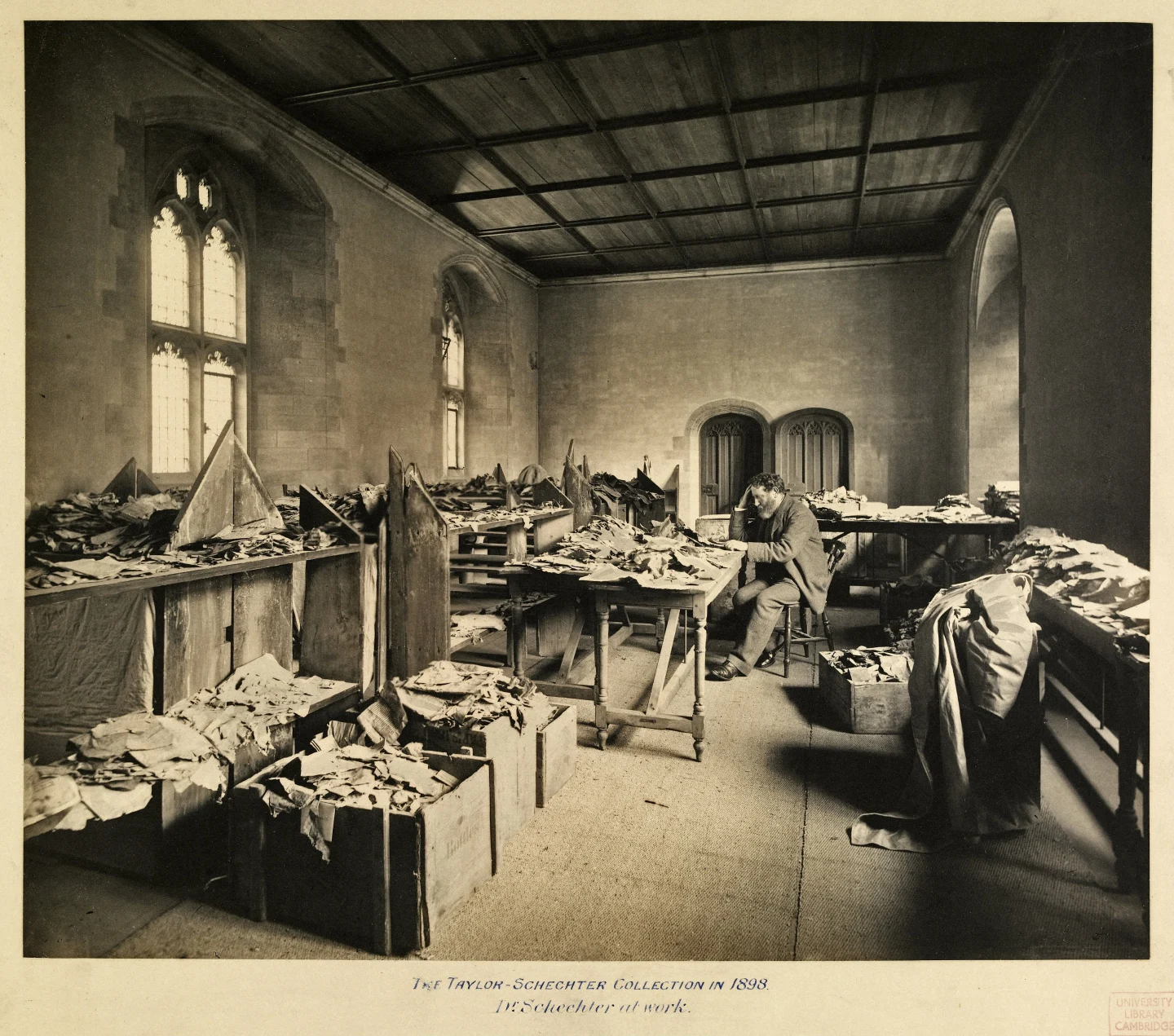
External evidence from the Cairo Genizah confirms the broader atmosphere Rabban inhabited. Its fragments include letters and shipping manifests referencing pepper shipments, Indian Ocean trade and merchants operating in Malabar. These records show that Jewish traders were part of a global commercial network stretching from Kerala to Cairo, Aden and beyond.
The Genizah is a massive collection of roughly 400,000 medieval manuscript fragments and everyday documents found in the storeroom of the Ben Ezra Synagogue in Old Cairo, Egypt. Spanning from the sixth to the 19th centuries, it is said to be the world’s largest and most diverse archive of medieval Jewish life.
Rabban’s story is therefore not an isolated episode but part of a larger Jewish mercantile presence that shaped the economic and cultural life of the Indian Ocean world.
The Cairo Genizah provides an extraordinary documentary window into the commercial world that connected Kerala to the Middle East. Its fragments preserve correspondence between merchants who described pepper cargoes, shipping routes and the rhythms of trade across the Indian Ocean. These letters reveal Jewish traders who navigated markets from Cochin to Aden and Cairo, participating in a commercial system that linked South Asia to the Mediterranean. Its records confirm that the Jewish presence on the Malabar Coast was part of a wider mercantile network sustained by trust, reputation and shared commercial interests.
When read alongside the Copper Plates, the Genizah provides external corroboration of the privileges Rabban received and the commercial authority he exercised. Together, these sources demonstrate that Cochin’s Jewish community was integrated into a global trading world whose documentary traces survive in both Indian and Middle Eastern archives.
Legacy across the continents
Most Cochin Jews migrated to Israel between 1950 and 1970, forming a vibrant community now in its third generation. Their departure marked the end of an era in Kerala, but their traditions and memories remain alive in their new homes. The synagogue in Cochin stands as a physical reminder of their origins, linking the present to the land where their ancestors lived for centuries. The Copper Plates remain India’s only known Jewish royal charter, demonstrating that a Jewish community found dignity, protection and identity in India.
The Cochin Jews integrated into Kerala’s cultural fabric while preserving their distinct traditions, creating a heritage that continues to inspire scholars and visitors alike. Their story reveals how minority communities can thrive through commerce, diplomacy and mutual respect. It also shows how trade can build bridges between communities and how legal recognition can secure a place for diverse groups within a broader society. The Cochin Jewish narrative stands as a testament to the possibilities of cultural integration and the enduring impact of historical documents.
The Copper Plates are more than a document. They are a declaration. They affirm that a Jewish community secured its place in India’s history with clarity, confidence and continuity. Their survival allows us to hear the voices of a community that contributed to the economic and cultural life of the Malabar Coast, shaping its history through trade and tradition. The plates stand as India’s only known Jewish royal charter; a rare example of formal recognition granted to a minority community whose contributions enriched the region for centuries.
In an era when global audiences seek stories of pluralism and civilizational exchange, the Cochini legacy offers one of the most compelling examples of how identity, commerce and culture can converge to create something enduring. It is a story of recognition, resilience and rootedness, preserved in copper and carried forward through memory.
The Cochin Jews demonstrated how a community can thrive through integration without assimilation, and how documentary clarity can anchor a people’s place in history with dignity and permanence.
More on this subject: India and Israel: The rediscovered alliance
Battle of Haifa: The Indian cavalry that freed the city in 1918