
Before anyone could determine whether the Lebanese Armed Forces could dismantle Hezbollah’s infrastructure, seize its weapons and establish state sovereignty in Southern Lebanon, the new pilot program designed to provide the Lebanese army with an opportunity to do so encountered its first test.
It did not involve missiles, tunnels or units of Hezbollah’s elite Radwan Force. It involved approximately 150 meters.
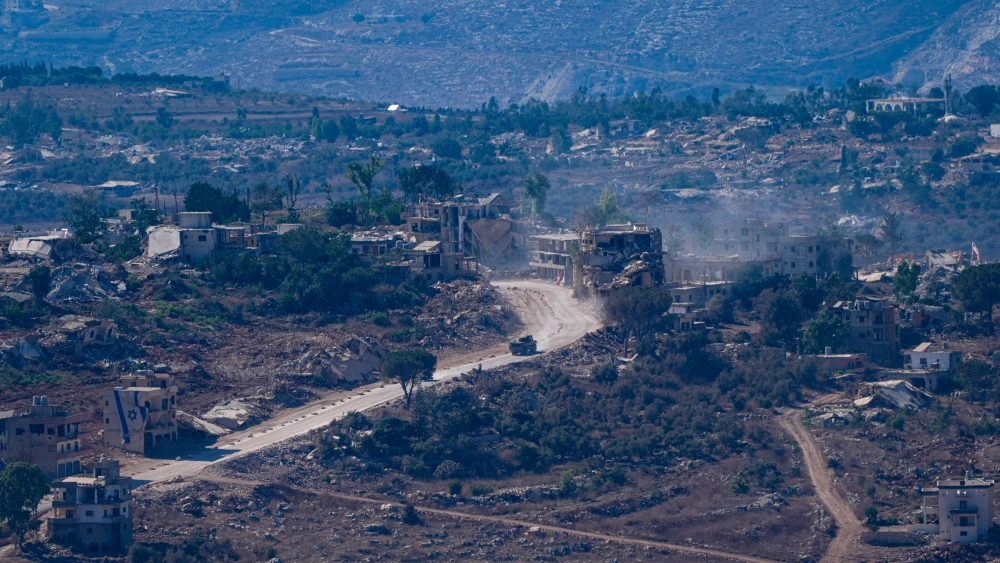
On July 21, the Lebanese army began deploying in the village of Zawtar al-Gharbiyeh after the Israeli military withdrew as part of the first stage of a U.S.-brokered framework. Lebanese teams began clearing unexploded ordnance. A neighboring village, Zawtar al-Sharqiyeh, remained inside the Israeli-held buffer zone.
The Israel Defense Forces said Lebanese soldiers and an engineering vehicle crossed barriers and advanced about 150 meters into the security zone near Zawtar al-Sharqiyeh, outside the agreed pilot area and without coordination. Israeli troops fired warning shots, and the Lebanese force withdrew without casualties.
The Lebanese army said its soldiers remained inside Zawtar al-Gharbiyeh and were operating through the prescribed coordination mechanism when Israeli troops opened fire nearby. It described the shooting as an act of aggression that endangered its soldiers and could obstruct the pilot program.
Perhaps this was a navigation error. Perhaps the maps were unclear. Perhaps the vehicle crossed the agreed line unintentionally. Perhaps the Lebanese account is correct. The facts should be investigated immediately through the established mechanism.
But this is not an argument about a 150-meter tactical dispute.
The strategic question is how Israel, Lebanon and the United States will resolve the first disputed incident. Will it be documented, investigated and corrected, or dismissed as a local misunderstanding too small to justify endangering a major diplomatic initiative?
Israel knows this trap well. Quite often, violations of agreements become precedents.
The lesson of Oslo is clear: What is not enforced at the beginning of a process will not be enforced later.
During implementation of the Oslo Accords, I served as an officer in the District Coordination Office (DCO), the joint Israeli-Palestinian coordination mechanism. We handled incidents in which the reality on the ground diverged from agreements signed on paper.
Palestinian security forces violated the Oslo Accords repeatedly and in a variety of ways. One example was the arrest and interrogation of Israeli citizens, particularly Arab Israelis who entered Palestinian Authority territory. These incidents were reported, investigated and discussed through the coordination mechanisms, but in many cases no meaningful consequences followed.
The explanation was familiar: The incident was serious, but not serious enough to risk the process. Palestinian institutions were still learning. The problem should be handled quietly so as not to strengthen the agreement’s opponents.
Thus, violations became the norm due to lack of enforcement. Then, the norm became an operating method. What began as an isolated deviation became permanent reality.
The problem was not only that the Palestinian side violated the agreements. It was also that Israel and the international community convinced themselves that each violation was too small to justify meaningful consequences. The more valuable the process became, the weaker the willingness to enforce it. The weaker the enforcement, the greater the incentive to test Israel’s tolerance.
That is precisely the danger in Lebanon.
Today, the dispute concerns 150 meters. Tomorrow, it could be entry into another area, a weapons warehouse left unsearched because of alleged “local sensitivities,” a Hezbollah operative classified as a civilian or an underground facility that supposedly cannot be found.
Each time, Israel will be told that the incident is minor, the Lebanese army is still building its capabilities, Beirut is under pressure, Hezbollah may react, and a historic agreement should not be derailed over a local malfunction.
Violations became the norm due to lack of enforcement. Then, the norm became an operating method.
That is how agreements erode. They do not always collapse due to one dramatic violation. Often, they are hollowed out by small breaches, each presented as too insignificant to justify a response. Later, the agreement remains on paper while the security reality it was meant to create has disappeared.
The timing of the latest incident was revealing. On the same day, Lebanese President Joseph Aoun met U.S. President Donald Trump at the White House. He spoke about ending the state of hostility, restoring Lebanese sovereignty and securing a full Israeli withdrawal.
Yet while Aoun spoke about sovereignty and state responsibility, the army he supposedly commands described Israeli warning fire as aggression that could impede the pilot program. The Lebanese army’s public response did not acknowledge the need for an impartial investigation. Instead, it immediately shifted responsibility onto Israel.
This is the first test of Aoun’s leadership: It is not about how he speaks about peace in Washington, but whether he can demand discipline, accountability and exact compliance from the Lebanese army when implementation becomes difficult.
Israel has a clear interest in the framework’s success: A stronger Lebanese state, an army acting as the country’s sole sovereign force and the dismantling of Hezbollah’s military power are desirable outcomes. But a White House meeting cannot substitute for performance.
Israel should not be asked to choose between supporting Aoun and protecting itself. In fact, precise enforcement is the only way to give Aoun a genuine chance to succeed. If Israel accepts violations to avoid embarrassment, it will teach both the Lebanese army and Hezbollah that continuation of the process matters more than fulfillment of its terms.
Therefore, Israeli withdrawals must not proceed automatically. Each stage should follow only after the previous one has been completed, verified and proven stable. The Lebanese army must demonstrate not merely symbolic presence, but the willingness and ability to confiscate weapons, close facilities, arrest operatives and prevent Hezbollah’s return.
Every deviation must be documented, investigated and corrected. That does not mean responding to every incident with equal force. Responses can be graduated and proportionate. Enforcement itself, however, cannot be negotiable.
Israel must also retain freedom of action wherever the Lebanese army fails to act. Responsibility for Southern Lebanon can gradually be transferred to Beirut, but promises or good intentions must not replace Israel’s ability to protect its northern communities.
The 150 meters themselves have little strategic importance. What they represent is decisive. If the Lebanese force crossed the line, the breach must be acknowledged and corrected. If unclear maps or an Israeli mistake caused the incident, Israel must correct its procedures. Either way, the facts cannot be blurred to preserve momentum.
If Israel does not insist on enforcing the agreement now, while the process is young and its rules are still being established, it will not be able to enforce it later. After the IDF withdraws and Washington invests political and financial capital, the diplomatic cost of every Israeli response will be far higher.
The lesson of Oslo remains clear: What is not enforced at the beginning of a process will not be enforced later. Those who overlook the first violation to save an agreement will eventually be asked to tolerate far more serious violations to prevent its collapse.
Israel must make the rules clear now: no withdrawal without implementation, no progress without verification and no violation without consequences.