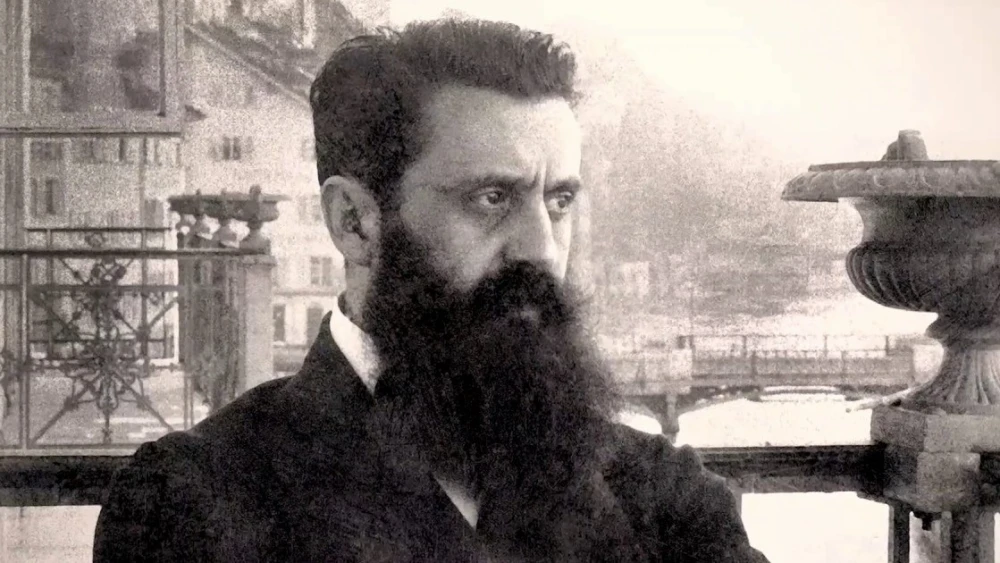

An event will take place on Aug. 5 on Mount Herzl in Jerusalem whose meaning extends far beyond a family ceremony. The remains of Simon Loeb and Rivka Herzl, the grandparents of Theodor (Binyamin Ze’ev) Herzl—the founding father of political Zionism—are expected to be brought from Zemun, Serbia, now part of Belgrade, and laid to rest beside their grandson. According to the World Zionist Organization, this initiative, undertaken in cooperation with the Serbian authorities and the local Jewish community, was postponed several times because of the security situation in Israel. Now, 77 years after Herzl’s own reinterment in Jerusalem, the historical circle may finally close.
In August 1949, the young State of Israel fulfilled Herzl’s wish by transferring his remains from Vienna to Jerusalem. His parents and sister were laid to rest beside him. In 2006, two of his children, Pauline and Hans, were reinterred in Israel. In 2007, his only grandson, Stephen Theodore Norman, followed. Now the turn has come for the generation that preceded Herzl. Yet this is about more than restoring a family burial plot. With Simon Loeb and Rivka Herzl, an important part of the history of the Zionist idea itself is returning to Jerusalem.
Today’s Zemun was called Semlin in the 19th century. It stood at the crossroads of empires, cultures and national movements. Simon Loeb Herzl lived there. A traditional Jew, he served as a hazzan and gabbai in the small synagogue of Rabbi Yehuda Shlomo Alkalai. Alkalai was among the outstanding forerunners of Zionism. Long before the First Zionist Congress, he argued that Jews could not merely wait passively for redemption. A return to the Land of Israel required human initiative, national unity, political action and practical steps.
In these ideas, it is easy to recognize the outlines of the program that Herzl would later turn into an international movement. Alkalai spoke of Jewish national representation, the purchase of land, the revival of Hebrew and the need to secure the support of the great powers. Simon Loeb was one of his devoted disciples and supporters. When visiting his son’s family in Budapest, he reportedly spoke about his rabbi and Alkalai’s call for a return to Zion.
A historian must not pass off a beautiful hypothesis as a documented fact. We do not know exactly what the grandfather said to the young Theodor. We cannot draw a straight line from the synagogue in Semlin to the program of the First Zionist Congress. Yet we cannot ignore another truth: Great ideas do not only enter a person’s consciousness through books and political upheavals. Sometimes, they are first heard in a family conversation, preserved in memory and buried deep for years. They return when biography and history compel a person to answer a question he had once avoided.
In my view, collective memory is not simply a storehouse of the past. It is continually reconstructed within changing social frameworks. This does not grant license to rewrite history at will. On the contrary, we must distinguish between a documented fact and its public interpretation. Yet interpretation determines whether a fact remains a private episode or enters a nation’s historical narrative. Family lore, a cemetery, a commemorative date and a state ceremony represent different stages of that passage.
The history of the Herzl family allows us to see this process almost tangibly. As long as Simon Loeb’s story was passed down among relatives, it belonged to the communicative memory of a few generations. Reinterment in Jerusalem moves this family story into the realms of cultural memory, ritual and public recognition. It becomes anchored in place.
The upcoming ceremony does not retroactively prove Alkalai’s direct influence on Theodor Herzl. It restores to public attention the environment in which Herzl may first have encountered the idea of an active return to Zion.
Herzl knew that a Jewish state cannot be built on Jews’ rejection of their own identity.
In my book Dilemmas and Achievements: On the National Character of the Modern Democratic State, I sought to trace this inner evolution through a discussion of Herzl and traditional Jewish values. Herzl did not emerge fully formed as a national leader. He was a man of European culture: A lawyer, journalist and playwright who believed in the promise of emancipation and integration. In his youth, he even considered a fantastical plan for the collective conversion of the Jews to Christianity as a way to end antisemitism. This detail is inconvenient for a heroic portrait, but essential to understanding Herzl. His greatness lay not in being infallible, but in his ability to reconsider his own illusions.
Antisemitism in intellectual salons and universities, mass hostility on the streets of European capitals, the Dreyfus affair and his experience as a journalist led Herzl to one conclusion: Even the deepest cultural integration could not guarantee Jews’ safety, equality or dignity. In The Jewish State, he wrote that, for centuries, Jews had tried to become loyal fellow citizens, offering societies their knowledge, labor and sacrifice, yet they continued to be regarded as outsiders. Herzl’s answer was not an escape from history, but the restoration of the Jews’ right to become agents of their own history.
Yet his political project gradually acquired a deeper meaning. At the First Zionist Congress, Herzl made a statement that is especially important to hear today without simplification: “Zionism is a return to Judaism even before there is a return to the Jewish land.”
This was not a call for theocracy. Herzl defended a modern civic order and freedom of conscience. His point was different: A Jewish state cannot be built on Jews’ rejection of their own identity. Political sovereignty loses its inner meaning without historical memory, solidarity and a sense of belonging to one people.
This is why the coming reinterment matters today. We live in an age when antisemitism once again offers Jews safety in exchange for invisibility and turns Israel’s right to exist into a matter for others to grant or withhold. Herzl teaches the opposite: The Jewish state did not arise as a privilege granted by others, but as the realization of a people’s right to self-determination, achieved through political will, diplomacy, labor and responsibility for its own future.
For the Jewish communities of Eurasia, this history carries particular meaning. The path of the Herzl family links Semlin, Budapest, Vienna, Basel and Jerusalem. It is a route across imperial borders, languages, assimilation, persecution and hope toward restored sovereignty. The return to Jerusalem does not erase the importance of the communities from which Herzl and his predecessors emerged. It reminds us that Israel and the Diaspora are not competing worlds, but parts of one historical destiny. Preserving Jewish life in Diaspora communities and strengthening their bond with Israel are two sides of the same responsibility.
A state capable of bringing its dead home after decades and more is not only a political entity. It is also an institution of national cultural memory. Mount Herzl is a place where the past enters a shared narrative about a people’s origins, responsibilities and future. But memory must not become decoration or a political instrument. Living memory obligates us to confront antisemitism, support Jewish education, strengthen communities and pass Hebrew, tradition and historical knowledge to the next generation.
When Simon Loeb and Rivka Herzl are laid to rest beside their grandson, a long journey from Semlin will end. Yet this is not an ending, but a meeting of generations. A grandfather who heard Rabbi Alkalai’s calls for a practical return to Zion will rest beside a grandson who turned an ancient hope into a political program, and that program into a movement that changed the fate of a people.
History rarely arranges its symbols with such clarity. By bringing Herzl’s forebears to Jerusalem, Israel restores one of the invisible threads that binds tradition to modernity, family memory to national will and a dream to state action.
It reminds us again that, before Zionism became a road to the land, it was a road back to ourselves.