


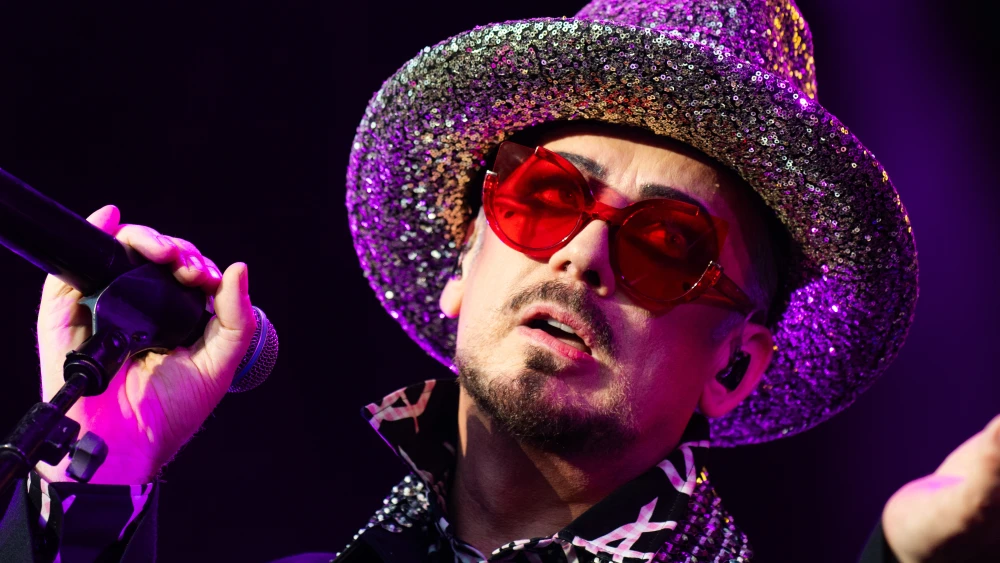

“If you’re ever confused, I stand with the Jews.” Those may be among the most consequential song lyrics released this year.
On July 27, Boy George released his newest song, “Od Nirkod” (“We Will Dance Again”), commemorating the victims of the Oct. 7, 2023 massacre in southern Israel. He most likely knew it would be controversial. He most likely knew there would be a price to pay.
In today’s entertainment industry, expressing solidarity with Israel or even with Jewish victims of terror is often met with criticism, professional backlash and public condemnation. Yet Boy George recorded the song anyway.
That decision matters. Not because Boy George is a politician. Not because he is Jewish. Not because he has spent his career as an advocate for Israel. It matters because he chose moral clarity over cultural conformity.
Immediately afterward comes an even more revealing line: “I don’t feel brave; I just need to behave like a human.” Those words should not sound courageous. They should sound ordinary. When standing with victims of terrorism is considered brave rather than simply human, something has gone terribly wrong.
Since the Hamas-led terrorist attacks in southern Israel on Oct. 7, we have witnessed what can best be described as Moral Inversion: a reversal of the moral order, in which victims become villains, terrorism becomes “resistance,” and evil is judged not by what is done, but by who does it.
He reminded us that before there are political movements, ideological labels or competing historical grievances, there are human beings.
Simply put, Moral Inversion occurs when the identity of the actor becomes more important than the nature of the act. Moral Inversion does not simply alter political opinions. It changes a society’s moral vocabulary. It teaches people to measure identical acts by different standards depending upon who commits them. It transforms selective outrage into virtue and moral consistency into controversy.
When our principles depend upon who the victim is, they are no longer principles; they are preferences. When Moral Inversion takes hold, telling the truth becomes an act of courage rather than an act of conscience.
No event better illustrates that inversion than Oct. 7, which should never have been morally complicated. Men, women and children were tortured, raped, murdered, kidnapped and, in many cases, their bodies were desecrated. Entire families were wiped out. Young people attending a music festival were hunted down simply because they had gathered to celebrate life.
Such atrocities should have elicited universal condemnation. The response to such atrocities should never depend upon politics, ideology or the identity of the victims. It should depend upon our shared humanity. When that moral instinct becomes conditional, we lose something far greater than consensus—our moral compass.
This is what happened. The conversation after Oct. 7 quickly shifted to justification, context and competing narratives. The massacre itself was too often pushed into the background while debates over politics took center stage.
#Shalom pic.twitter.com/0BfHIrThzO
— Boy George (@BoyGeorge) July 26, 2026
Boy George refused to participate in Moral Inversion. He refused to redefine evil to make it acceptable. He has reminded us that before there are political movements, ideological labels or competing historical grievances, there are human beings.
His declaration, “If you’re ever confused, I stand with the Jews,” is not simply about Israel. It is about refusing selective humanity. It is about insisting that Jews deserve the same empathy afforded every other minority community. That should not be controversial.
Perhaps nowhere is this contradiction more striking than among those who proudly champion gay rights while embracing movements that offer those rights little or no legal protection. Among Middle Eastern nations, Israel stands alone in affording gay and lesbian individuals robust legal protections. By contrast, in the vast majority of Muslim-majority countries, homosexuality remains a criminal offense, with penalties ranging from imprisonment to capital punishment.
One need not agree with every policy of the Israeli government to recognize that reality. Nor must one abandon compassion for innocent Arab civilians to condemn Hamas. Those are not contradictory positions but the product of moral consistency.
This is not really an article about Boy George. It is about a culture that has become so morally disoriented that saying, “I stand with the Jews,” is viewed by many as courageous. It isn’t. It is human.
History has a way of revealing profound truths through the most unexpected voices. The people who remind us of first principles are not always philosophers, clergy or statesmen. Sometimes, they are artists who refuse to surrender their humanity to the demands of the moment.
If saying, “I stand with the Jews,” is now considered courageous, then the problem is not Boy George. It is a culture that has forgotten the difference between popularity and principle. Humanity should never require courage.



