
Among the many paradoxical blessings of longevity is the curse of watching one’s friends not merely die—as banally speaking, we all must—but realizing that you are among the handful left who still know how much more there is beyond the public persona of the friend you’ve lost. That is, assuming such a persona actually managed to exist, given that popular credit is not a priority for those most worthy of it. That we are vessels for a larger purpose, they already know.
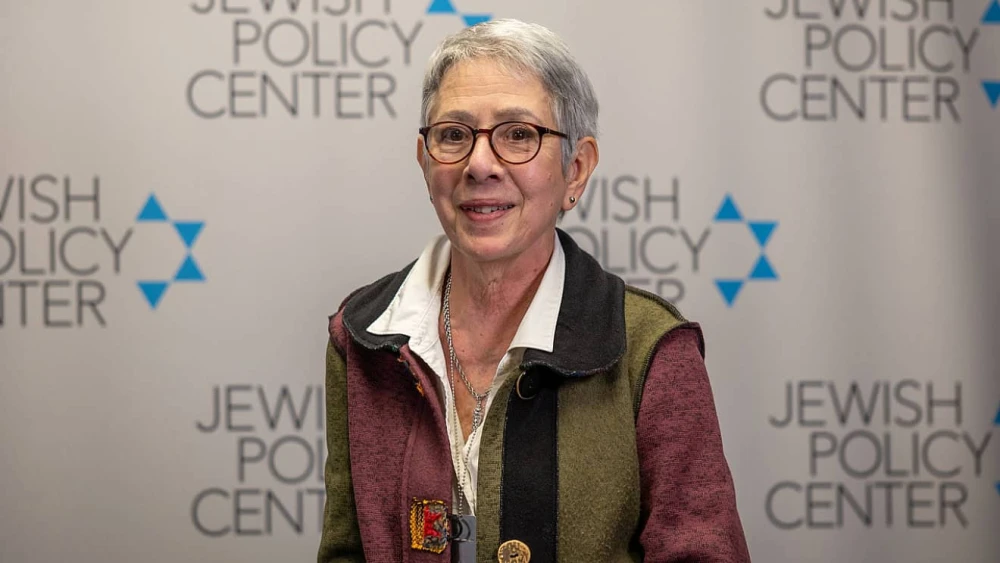
So I come with a heavy heart, from which a large piece was torn last week when Shoshana Bryen stopped wrestling with one last angel. A public persona she did indeed have. Already in her 20s, she became actively involved in Jewish affairs and human rights through the Jewish Institute for National Security Affairs (JINSA), as senior director for security policy, where she focused on planning and running national security-related programs and conferences.
In 1989, Shoshana became JINSA’s executive director. It was under her leadership that a minor think tank became a world-renowned networking and educational power center. JINSA began organizing missions and meetings with national leaders and officials throughout the world to advance U.S. security and world peace—not in the Communist, Orwellian, Big Lie sense, but ineluctably tied to liberal principles. One of the institute’s goals was cultivating Israel as America’s faithful ally, for the benefit of both nations and the Free World.
When she left JINSA three decades later, in 2012, her record had been cemented: She had been principally responsible for it having become one of the most significant conservative, pro-Israel and pro-human rights organizations in the United States.
The elegance with which this diminutive, beautiful lady could display such iron determination, social savvy and political knowledge was surpassed only by a managerial ability no business school can teach. She was not a mere administrator, quite the contrary. Besides writing informative and erudite reports that were widely disseminated, read and republished, she worked with the Strategic Studies Institute of the U.S. Army War College, the Institute for National Security Studies in Tel Aviv and lectured at the National Defense University in Washington, among other places.
In 2012, she moved to the Jewish Policy Center, where she became its intellectual heart.
As senior director, she began editing the inFOCUS Quarterly, one of the most influential and widely read journals not only in the United States but abroad. Her work has appeared in The Wall Street Journal, The New York Sun, Defense News, JNS, as well as other news outlets and journals, not to mention podcasts, lectures and a myriad other places.
None of which even begins to give you a glimpse into Shoshana, the mother. Her love for her children—Gabrielle, Ari, Mollie and Sarah—and five grandchildren does not fit into the poor words of even a poem, let alone an editorial. How both she and her genius of a husband, Stephen Bryen, stepped in for me when my husband was on the threshold of the netherworld, suffering from totally unexpected complications after cancer surgery, is also beyond my ability to describe. And there is so much else.
But I think there are some words appropriate here that are Shoshana’s own, from June 2012, published in The Times of Israel, titled “Israel and the Boat People.”
She was commemorating 35 years since 66 Vietnamese refugees, who were fleeing the Communist takeover of their homeland on a small, leaky boat, found deliverance.
She wrote: “They were without food and water and ships from Panama, Norway and Japan had ignored their distress signals (violating the most basic rule of the sea). They despaired of rescue. Captain Meir Tadmor of the Israeli cargo ship “Yuvali” was on his way to Japan when he saw them on 10 June 1977.
“The ‘Yuvali’s’ chief engineer wrote the following: ‘I was there. In South China Sea, close to Vietnamese coast, we met small fishing boat, few people on the deck, asking for food and water. We stop ship, and first wanted to give them as they asking: food and water, but then come on the deck a woman with small baby in the hands, and told us that they are Vietnamese refugees. That is when we decided to take all on board. … Their leader was the only one to talk English, very nice person, he was with family—wife, child, wife’s sister and parents. We took care of them, give them proper food and accommodation.’
“After receiving permission from the Israeli government to find them refuge, Capt. Tadmor made an unscheduled stop in Hong Kong, which refused to allow the ship to dock. He sailed on to Taiwan, where the refugees were refused because they had no citizenship. That would be fixed. In his first official act, newly elected Israeli Prime Minister Menachem Begin made the Vietnamese citizens of Israel. The Taiwan government then allowed the former refugees to enter the country, receive assistance and be taken to the airport for their trip to Israel, the first of nearly 300 Vietnamese refugees to find safe harbor there. At the ceremony to welcome them, Israeli Minister of Immigrant Absorption David Levy chastised those who had ignored the leaky, dangerous boats and ignored their hungry, sick and desperate passengers: Let them do as we have. May they lend a hand to save women and children who are in the heart of the sea without a homeland, and lead them to safe shores. Israel understood boat people because Jews in living memory had been boat people.
“Prime Minister Begin told President Carter: ‘We never have forgotten the boat with 900 Jews, the St. Louis, having left Germany in the last weeks before the Second World War … traveling from harbor to harbor, from country to country, crying out for refuge. They were refused … Therefore it was natural … to give those people a haven in the Land of Israel.’
“There was the ‘St. Louis,’ and there were other boats.
“More than 100,000 Jews tried to reach Palestine by sea between 1934 and 1948 on 120 ships making 142 voyages. Only a few thousand made it to Israel that way. More than 1,600 drowned. More than 1,000 were killed on the ‘SS Struma’ (768 dead, one survivor) and the ‘Mefkura’ (345 dead, five survivors), both sunk by Soviet torpedoes. The British interned as many as 50,000 in Cyprus, or back in Germany, including the passengers of the ‘Exodus’ in 1947. The Hannah Senesh docked; the ‘Enzo Sereni’ didn’t. The ‘Salvador’ and the ‘Europa’ were wrecked in storms.
She reflects on the charge hurled at Israel of indifference to Arabs, especially considering the record of its accusers. Given the astounding indifference of the entire world, including America, to innocent Jews trying to escape annihilation on the eve of the Holocaust, such accusations are preposterous. Quite the contrary, she argues, “[t]he experience of Jewish refugees and the hopelessness of statelessness made Israel sensitive to the hopelessness of people from another place, another culture, another war, giving the Vietnamese a place to start over.”
Yet 14 years later, after she wrote these words, where are we?
The accusations against Israel have reached the nadir of obscenity. The one people whose history is an endless series of constant perilous journeys, after being expelled from practically every place of temporary refuge, is being condemned as genocidal and colonialist.
Why? Because it dares to defend the one sliver of its original land—obtained in conformity with international agreements—against repeated armed attacks and terrorism.
Shoshana ends her piece with a touching story:
“Some of the Vietnamese left Israel, looking for a more familiar culture (and seeking Vietnamese spouses for their children), but others stayed. You can see the story of Hanmoi Nguyen, who remained in Israel, and his five daughters in the film, ‘The Journey of Vaan Nguyen.’ The ‘Yuvali’s’ chief engineer left his e-mail on his blog post so the Vietnamese could contact him, saying, ‘I do believe that they all remember me.’”
No doubt they do.