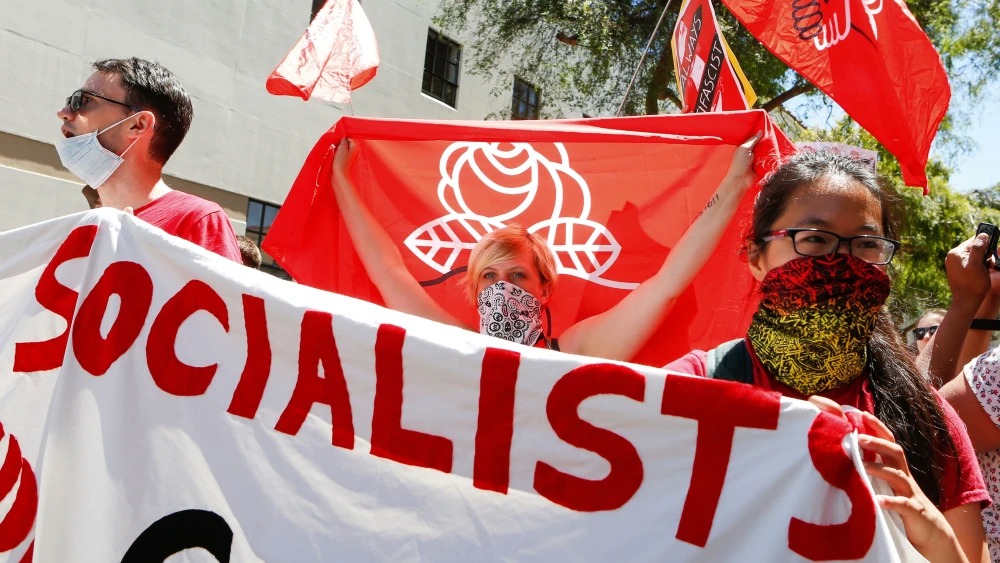

Since Zohran Mamdani’s mayoral victory in New York City, the Democratic Socialists of America and self-described progressive left have strung together a series of wins that should alarm anyone paying attention.
The trend has surfaced in New Jersey, Michigan and Minnesota, where Lt. Gov. Peggy Flanagan recently defeated moderate Rep. Angie Craig for the Democratic Senate nomination after making the genocide libel that demonizes Israel a centerpiece of her campaign.
Now it has reached Florida. There, state Rep. Angie Nixon, who joined the DSA during her campaign, upset retired Army Lt. Col. Alex Vindman, former director of European Affairs for the National Security Council, for the Democratic Senate nod.
Whether or not they carry DSA membership cards, their positions on Israel are increasingly indistinguishable from the organization’s platform. Worse is how little resistance this has met from mainstream Democrats, whose silence or outright embrace has let the Overton window slide to accommodate figures like Twitch streamer Hasan Piker, who campaigned alongside Michigan Senate candidate Dr. Abdul El-Sayed, despite saying that he would choose Hamas over Israel “every single time.”
This is not a fringe caucus anymore. It is fast becoming the ideological engine of the Democratic left. The late Rabbi Jonathan Sacks warned that antisemitism mutates to fit the moral fashion of the age.
Soviet refusenik and Israeli statesman Natan Sharansky showed how to recognize it by the three “3D test”: double standards, demonization and delegitimization directed at the world’s only Jewish state.
Those insights explain the drift inside DSA. It need not resemble the antisemitism of the last century to accomplish the same end. The vocabulary has changed. The target has not.
At its 2025 convention, DSA delegates passed Resolution 22, “For a Fighting Anti-Zionist DSA.” It branded Zionism a “racist, imperialist, settler-colonial project” and made stating that “Israel has a right to defend itself” an expellable offense.
That is Sharansky’s “delegitimization,” written directly into party doctrine. A movement whose founder, Michael Harrington, once defended Zionism as the Jewish people’s national liberation movement now expels members for saying it.
The “double standard” is just as explicit. DSA’s 2026 platform, Workers Deserve More, demands an end to all aid to Israel and prosecution of Israeli leaders for “genocide,” while calling to end sanctions on Cuba, Venezuela and Iran. It asked Washington to accommodate some of the world’s (then) most repressive regimes while severing ties with the Middle East’s only democracy.
Only one state is singled out by the DSA as fundamentally illegitimate, and it is not the one jailing dissidents or hanging gay men from cranes.
The colonialism argument is equally revealing. DSA brands Israel a uniquely “colonial” project while urging accommodation of Iran, whose rulers seek regional hegemony and whose predecessors built empires across non-Persian peoples for centuries.
Colonialism here is not a historical category but a political accusation, applied with striking selectivity. Empires, conquests and systems of domination fade into the background when practiced by favored regimes. Only the tiny Jewish state is treated as permanently disqualified by the charge.
That same platform ties ending Israel’s military aid directly to a domestic wish list: universal healthcare, a jobs guarantee, free housing. The implication—stated outright in DSA literature—is that American social problems persist because resources are diverted to Israel, despite the nation’s receiving less than 0.05% of U.S. government spending. It repackages a familiar form of scapegoating, casting the Jewish state as an outsized obstacle to domestic prosperity, despite its tiny share of U.S. spending.
If the ideology is dangerous, the ignorance underneath it might be worse. DSA national co-chair Megan Romer sat for an extended interview earlier this month with David Remnick of The New Yorker. Asked whether DSA would have supported the Palestinians accepting the terms offered at the 2000 Camp David summit, arguably the most consequential turning point in the modern conflict, Romer said she’d need to “look up the specifics.”
Pressed on whether Israel has a right to defend itself, she wouldn’t affirm it. Asked whether she’d have joined the rally in New York City on Oct. 8, 2023 that celebrated the Hamas-led massacre in southern Israel just a day earlier, she said she “probably would have,” calling Oct. 7 “largely inevitable” because Gaza was, in her telling, an “open-air concentration camp.”
That answer requires erasing an inconvenient amount of history: the Second Intifada from 2000 to 2005, which followed the Palestinian rejection of that same Camp David offer; the Oslo Accords in the 1990s; Haj Amin al-Husseini’s wartime alliance with Adolf Hitler in the 1930s; the 1929 Hebron massacre—a full century of rejectionism proving no Palestinian statehood offer would ever be enough so long as a sovereign Jew remained anywhere in the land.
Romer then described DSA’s actual position as “a free Palestine with a capital in Jerusalem,” which she agreed amounts to a one-state solution: the end of Israel. This is the national co-chair of an organization with more than 100,000 members and roughly 250 elected officials, unable to address basic facts about the conflict she wants America to abandon its ally over.
This is precisely what Sacks meant. Antisemitism doesn’t require knowledge of its target, only a story that needs a villain. Romer doesn’t need to know what happened at Hebron in 1929 or Camp David in 2000 to be certain that Israel is somehow the obstacle to peace.
The DSA doesn’t need to explain why Cuba and Iran deserve normalization while Israel deserves prosecution. The scapegoat comes first. The reasoning, when it comes at all, arrives later—thin, ignorant and improvised, like Romer’s answers.
None of this hate and ignorance stayed contained in DSA platforms or resolutions. It elected the mayor of America’s largest city. It just won a Senate nomination in Florida. It is now shaping Senate primaries in Minnesota and Michigan, and congressional races from Colorado to New Jersey, carried by candidates who seldom say “socialist” out loud, but who arrive at the identical conclusion on Israel by way of the same hostility or historical illiteracy.
That is the actual danger. Not that the DSA will govern the country, but that its framework—demonization, delegitimization and double standards advanced by people who cannot answer basic questions about Middle East history—has quietly become respectable across a far wider swath of the Democratic Party than most people realize.
Sacks and Sharansky gave us the language to name what we’re seeing. The obligation now is to use it, clearly and unapologetically, before the mutation becomes the mainstream.