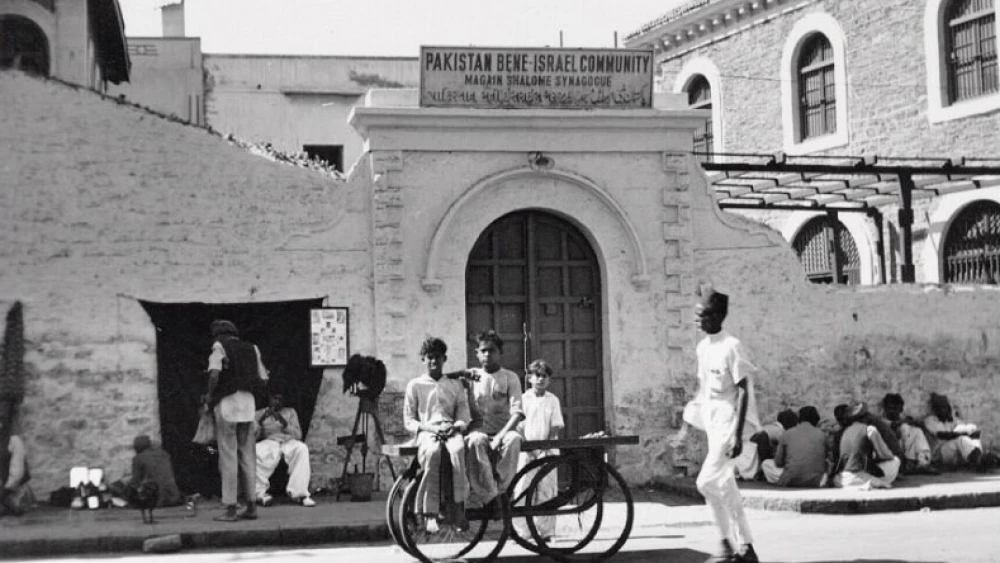

For the Jews of Karachi, Pakistan, Friday evenings once followed a familiar rhythm. A century ago, as the sun descended over the Arabian Sea, families would make their way to the Magain Shalome Synagogue to welcome the Sabbath.
Women had already lit Shabbat candles before leaving home. Men greeted one another at the entrance while children settled beside parents and grandparents. Soon the sanctuary filled with the sounds of Hebrew prayer, recited in the distinctive cadence of the Bene Israel Jews whose families had come to Karachi from western India.
The synagogue stood at the center of a small but flourishing Karachi Jewish community. Weddings were celebrated there, children received Jewish instruction, and families gathered on Shabbat and the festivals. It was a place of worship, but also a school, meeting hall and social center.
Today, the congregation is gone, the synagogue has been demolished, and most Pakistanis are probably unaware that Jews ever lived in their country.
That omission is all the more striking because Karachi’s Jews were not marginal outsiders. They served in municipal government, worked in commerce and the professions and helped shape the physical appearance of the city. Their story is part of Pakistan’s history, even if Pakistan has largely chosen to forget it.
Most of the Jews who settled in Karachi belonged to the Bene Israel, an ancient Indian Jewish community whose members had preserved circumcision, Shabbat and certain dietary practices despite centuries of isolation. Under British rule, many entered the military, civil service, commerce and the professions.
During the nineteenth century, Karachi developed rapidly into one of the subcontinent’s most important ports. Bene Israel families began arriving from Bombay, India and nearby areas, attracted by the commercial opportunities and the expanding colonial administration.
Their numbers were never large, and estimates vary considerably. The British census counted 153 Jews in Sindh in 1881 and 482 two decades later, nearly all of them in Karachi. Some accounts place the community at its peak at approximately 2,500 people, while recollections of former residents offer higher figures.
Whatever the precise number, the community possessed the institutions needed to sustain an active Jewish life.
Its most important building was the Magain Shalome Synagogue, erected in 1893 through the generosity of Solomon David Umerdekar, a municipal surveyor and communal leader. With its imposing facade, community halls and Hebrew school, it became both a Karachi landmark and the center of Jewish life.
Segula Moses, who was born in Karachi and later moved to Israel, recalled that wedding invitations were posted in the synagogue and the entire community was expected to attend. Karachi’s Jews formed a close-knit community, but they were also well integrated into the city around them.
Among the most prominent was Abraham Reuben, who served on the Karachi Municipal Corporation in the 1930s. His election reflected the degree to which Jews had become accepted participants in civic life.
An even more visible mark was left by Moses Somake, a Jewish architect born in Lahore in 1875. Somake designed some of colonial Karachi’s most striking buildings, including Mules Mansion, the B.V.S. Parsi High School and Flagstaff House, which was later associated with Pakistan’s founder, Muhammad Ali Jinnah.
Somake’s buildings combined European and local influences and helped define the character of the city. Many still stand, though few of the people who pass them each day are likely to know that they were designed by a Jew.
Decline was gradual, rather than immediate
That fact alone should give Pakistanis pause. Jewish history in their country is not confined to an abandoned cemetery or old photo. It is built into Karachi’s streets.
Former Jewish residents generally remembered cordial relations with their Muslim, Hindu, Christian and Parsi neighbors. Jews attended local schools, operated businesses and entered public service. The creation of Pakistan in August 1947 did not immediately bring that world to an end.
Until then, present-day India and Pakistan had formed part of colonial British India. When British rule ended, the subcontinent was partitioned into two independent states: predominantly Hindu India and mostly Muslim Pakistan.
The division triggered one of the largest and bloodiest migrations in modern history, as millions of Muslims fled to Pakistan while millions of Hindus and Sikhs moved in the opposite direction. Vast numbers were murdered in communal violence or died during the upheaval.
Karachi’s Jews were largely outside that conflict, and many initially believed they could continue living as before. The establishment of Israel the following year altered the atmosphere dramatically.
Though Pakistan’s Jews had no role in the Arab-Israeli conflict, they increasingly found themselves judged in light of events thousands of miles away. Anti-Jewish demonstrations took place, the Magain Shalome Synagogue was attacked and families that had long felt secure began to reconsider their future.
The community’s decline was gradual rather than immediate.
Some Jews moved first to India and later to Israel. Others settled in Britain, Canada or the United States. A smaller number remained in Karachi into the 1960s and 1970s, maintaining Jewish life as best they could while watching their community shrink around them.
Making Aliyah required discretion because Pakistan did not recognize Israel. Families left ostensibly for India, Britain or other destinations before continuing to the Jewish state, sometimes traveling through Bombay and Tehran. In doing so, they left behind homes, friendships, family graves and a city their community had helped develop.
Pakistan cannot fully understand Karachi’s past while erasing the Jews who helped shape it.
Many Pakistani Jews eventually settled in the city of Ramle in central Israel, where they established a synagogue named Magain Shalome Karachi. The name preserved a connection with the congregation they had left behind and ensured that Jewish Karachi would not disappear entirely. That synagogue continues to serve descendants of the community and keeps the memory of the original congregation alive.
One of the most poignant figures in the community’s final years was Rachel Joseph.
Born in Karachi in 1921, she remained in the city long after most other Jews had departed. As the community dwindled, she became one of the last people still trying to protect its property and preserve its rights.
In 1988, the Magain Shalome Synagogue in Karachi was demolished by Pakistani authorities to make way for a commercial development. Those responsible reportedly promised to provide the Jewish Trust with replacement property, including space for a new synagogue and apartments.
The promises were not honored.
Rachel Joseph spent years pursuing the matter in court. By then, there was scarcely a congregation left to defend, but she refused simply to abandon what remained of the community’s assets.
The synagogue represented decades of Jewish life: services, study, weddings, celebrations and the memories of families who had already scattered across the globe. Its destruction marked the disappearance of the community’s most important public symbol.
In late 2004, at the age of 83, Rachel finally called it quits.
Her departure was planned quietly because relatives feared that publicity might prevent her from leaving. With assistance from the Jewish Agency, she traveled first to London and then boarded an El Al flight to Israel.
According to her family, when she arrived at Ben-Gurion International Airport, she kissed the ground and declared that she had reached the Holy Land.
The moment carried unusual weight. Rachel was not a young immigrant coming to build a future. She was an elderly woman who had watched nearly the entire Jewish world of her childhood disappear. Her Aliyah brought the last custodian of that world to Israel.
She died there two years later.
Although some reports described Rachel as Pakistan’s last Jew, scattered and difficult-to-verify accounts have since emerged of families that concealed Jewish origins after 1948. The most visible contemporary example is Fishel Benkhald.
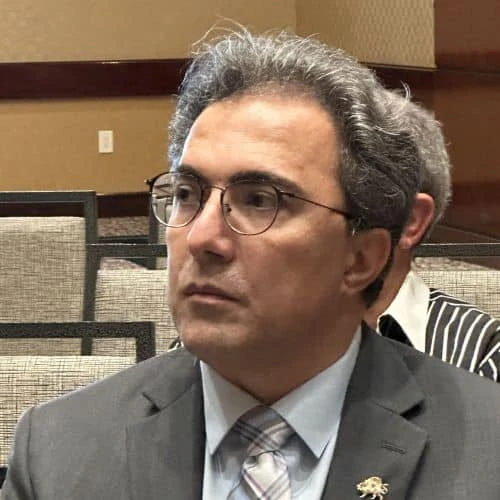
The son of a Jewish mother and Muslim father, Benkhald fought for years to be officially registered as Jewish on his Pakistani identity documents.
Government records had identified him as Muslim. After a prolonged struggle, the authorities eventually recognized his Jewish identity on his official documents; an extraordinary development in a country where organized Jewish life had disappeared decades earlier.
That recognition did not make life simple.
Benkhald has described concealing his kippah beneath a baseball cap and avoiding unnecessary public discussion of his religion. Still, he has worked to draw attention to Pakistan’s Jewish past and preserve what remains of it. In 2022, he visited Israel as part of a delegation promoting dialogue between Israelis and Muslims. He toured Yad Vashem in Jerusalem, met Israeli officials and expressed hope that Pakistan would one day establish diplomatic relations with the Jewish state.
The depth of historical amnesia
That hope faces formidable obstacles.
Pakistan still refuses to recognize Israel, and Pakistani passports explicitly state that they are valid for every country except the Jewish state. Its opposition has not been confined to diplomatic policy. Senior Pakistani officials have repeatedly employed incendiary rhetoric against Israel and its leaders.
In January 2026, Pakistani Defense Minister Khawaja Asif publicly urged the United States and Turkey to “kidnap” Israeli Prime Minister Benjamin Netanyahu. Three months later, he described Israel as “evil,” “a curse for humanity” and “cancerous,” prompting Israel’s Prime Minister’s Office to denounce his remarks as a call for Israel’s annihilation.
Benkhald’s efforts to preserve the memory of Pakistan’s Jews therefore stand in sharp contrast to the country’s official posture toward the Jewish state.
Yet despite decades of neglect and disappearance, echoes of that forgotten community can still be found.
In Karachi, the most visible reminders are in the city’s cemeteries.
At the Mewa Shah graveyard, weathered headstones bear Hebrew inscriptions, Stars of David and the names of men and women who once formed part of the city’s daily life. Some graves date back more than 170 years. Others have deteriorated or disappeared because of neglect and encroachment.
Another former synagogue building, a smaller one in the Ramaswamy area, is said to survive in altered form, stripped of its original purpose and difficult to recognize.
Together, these remnants expose the depth of Pakistan’s historical amnesia.
The history of Karachi’s Jews also complicates the assumption that Jews and Muslims in South Asia were always destined to live in hostility. For much of the community’s existence, ordinary relations were generally peaceful. It was the importation of the Arab-Israeli conflict into local life that turned longtime neighbors into objects of suspicion.
That history deserves to be acknowledged, particularly in Pakistan itself.
Preserving a Jewish cemetery or identifying the Jewish architect behind a prominent building is not an endorsement of Israeli policy, nor does it require taking sides in the Middle East conflict. It is simply an act of historical honesty. Pakistan cannot fully understand Karachi’s past while erasing the Jews who helped shape it.
The Magain Shalome Synagogue is gone, and the congregation that once filled it with prayer has dispersed. Yet the community has not disappeared without a trace. Its descendants live in Israel and elsewhere; its name survives on a synagogue in Ramle; and its gravestones and buildings continue to testify to what once existed.
For too long, Pakistan’s Jews have been treated as though they were never there. It is time to restore them to the history they helped to make.