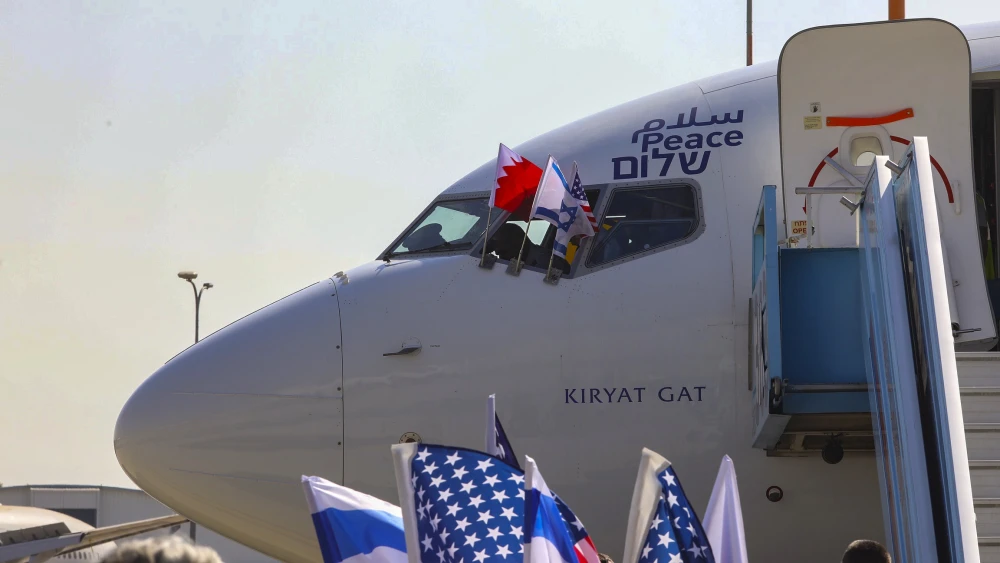

Long before oil transformed the Arabian Gulf, skyscrapers rose over Manama, and the Abraham Accords brought Israel and Bahrain into open diplomatic partnership, Jews were already part of the region’s story.
Their presence in Bahrain reaches back well over a millennium, to a time when the Gulf was a crossroads of trade, travel and faith. Indeed, to understand the importance of Bahrain’s Jewish community, one must first remember that the term “Bahrain” once referred not only to the modern island kingdom, but to a broader region along the eastern coast of Arabia.
Jewish sources, Arabic accounts and medieval travel literature all point to a Jewish presence in that wider Gulf area long before Islam.
The Talmud (Yoma 77a) mentions the “seaport of Mashig” and indicates that Jews resided there. In his commentary, the Ben Ish Hai (Rabbi Yosef Haim of Baghdad, 1835-1909), states, “it appears that the port of Mashig is the place that is now called by the name Bahrain.”
There are also references to Jews living in Hajar, then the capital of Bahrain, at the time of the early Islamic conquests. In 629 C.E., according to historical accounts, Muhammad sent Al-Ala’a Al-Hadhrami to the ruler of Bahrain, calling on its inhabitants to accept Islam. Many did, but some communities, including Jews, chose to retain their faith.
That detail is striking. More than 1,300 years ago, Jews were living in the region, recognized as a distinct religious community. They were not newcomers, outsiders or colonialists. They were part of the human landscape of Arabia and the Gulf.
Centuries later, the great 12th-century Jewish traveler Benjamin of Tudela (also known as Benjamin ben Jonah) described Jewish communities in the wider Gulf. He recorded Jews living in commercial enclaves, including Al-Qatif, northwest of Bahrain, and noted their involvement in the pearl trade. In those days, pearls were one of the region’s great sources of wealth, and Jewish merchants, like others, moved through the ports and markets that linked Arabia, Persia, India and beyond.
This ancient background matters because it reminds the world of something too often forgotten: Jewish life in the Middle East did not arrive in the region as an import. Jews lived, traded, prayed and built families across the Arab and Muslim world for centuries.
A physical reminder
The modern Jewish community of Bahrain took shape in the late 19th century, when Jewish families from Iraq, Iran and India settled in Manama. The Yadgars came from Iraq in the 1880s. The Nonoos, Khedouris, Cohens and Roubens became familiar names. Some worked in textiles and linens; others in gold, silver, banking and trade.
Ebrahim Nissim Nonoo, who was born in 1897, reportedly began as a zerryattiya, someone who extracted gold and silver threads from old garments and melted them down for resale. He eventually became a successful businessman and a member of the Manama Municipality, the capital’s city council.
In time, Bahrain’s Jews became woven into the island’s civic and commercial life. They established a mikvah, maintained a cemetery and built a synagogue in Manama in the 1930s, when the community was nearing its peak. Al-Mutanabi Road came to be known as the “Jewish market,” or “Jews’ Street,” because so many shops there were owned by Jews and closed on Shabbat.
Today’s synagogue in Manama, known as the House of Ten Commandments, is a relatively modern building. But it stands as a physical reminder of a much older Jewish presence—one that stretches back through the markets, ports and caravan routes of the Gulf.
At its peak in the 1930s and 1940s, Bahrain’s Jewish community may have numbered as many as 1,500 people. That is small by the standards of Baghdad, Aleppo or Casablanca, but for the Gulf, it was significant. Bahrain was never a great center of Torah scholarship or rabbinic authority. But it was home. Jewish families celebrated holidays, conducted business, buried their dead and contributed to the country around them.
Then came the rupture.
In December 1947, after the United Nations had voted to partition the Land of Israel, violence struck Manama’s Jewish quarter. Jewish homes and shops were looted. The synagogue was ransacked. Torah scrolls were stolen. One Jewish woman was killed, and others were injured.
For Bahrain’s Jews, the shock was devastating. Many had lived peacefully with their Muslim neighbors for years. The effect was irreversible and the sense of security had been shattered.
Many Jews left for Israel, Britain or the United States. After the 1967 Six-Day War, more departed. By the beginning of the 21st century, only a few dozen remained.
That is what makes Bahrain’s Jewish story so unusual. In many Arab countries, Jewish history became a matter of abandoned synagogues, crumbling cemeteries and memories preserved in exile. In Bahrain, however, a remnant, albeit small, endured on the island itself.
More than that, Bahraini Jews continued to play a visible role in public life. Ebrahim Daoud Nonoo became a member of Bahrain’s Shura Council. His cousin, Houda Nonoo, made history in 2008 when she was appointed Bahrain’s ambassador to the United States, becoming the first Jewish ambassador sent abroad by an Arab country. Nancy Khedouri, author of a history of Bahraini Jewry, has also served in the Shura Council and worked to preserve the community’s heritage.
For a Jewish community numbering perhaps 30 to 50 people, that is extraordinary. Bahrain’s Jews were not merely relics of a vanished past; they were citizens with names, voices and responsibilities.
The Abraham Accords did not create this history. The agreement revealed it.
A living bridge
After Bahrain and Israel normalized relations in 2020, doors that had long been closed began to open.
Bahraini Jews could reconnect more freely with Israel and with the wider Jewish world. The synagogue was renovated and reopened for public worship. Jewish visitors began to arrive. The Jewish Agency of Israel worked with the community to strengthen education and identity. Efforts were also made to restore and preserve the Jewish cemetery, where older graves tell, in silence, of a community that once was far larger.
More than 1,300 years ago, Jews were living in the region, recognized as a distinct religious community, and part of the landscape of Arabia and the Gulf.
This is why Bahrain’s Jewish story matters.
It reminds us that Jews lived across the region for centuries. They spoke its languages, knew its markets, shared its rhythms and contributed to its development.
Bahrain’s Jewish community today is tiny, but its significance is immense. It stands as a living bridge between the ancient Jewish presence in Arabia, the Mizrahi mercantile networks of the modern Gulf, the trauma of 1947 and the possibilities opened by normalization.
Recent Iranian missile and drone attacks on Bahrain since the start of the U.S.-Israel war against Iran on Feb. 28 are a reminder that those possibilities are not guaranteed. The Gulf state remains in the crosshairs of conflict.
In a region where Tehran still seeks to spread fear and instability, Bahrain’s decision to preserve its Jewish heritage and maintain ties with Israel takes on added meaning. It is a quiet declaration that Jewish memory in the Gulf will not be erased.
The synagogue in Manama is therefore more than a restored building. It is a witness.
It testifies that Jewish history in the Gulf is real and that coexistence was not merely a diplomatic slogan but a lived reality in markets, neighborhoods and families. And it testifies that even after hardship, fear and dispersal, a small community can carry a very long remembrance.
In Bahrain, that memory still has a home.