
This weekend, Britain’s Green Party voted to define Zionism as a form of racism, reviving a formulation once promoted by the Soviet Union. That a British political party can now treat the Jewish claim to national self-determination as inherently racist says much about how profoundly Jewish life in Europe has changed since Oct. 7, 2023.
Three years after the worst massacre of Jews since the Holocaust, the change extends far beyond politics. European Jewish life has been permanently altered. Most visibly, ordinary Jewish existence now takes place behind an extraordinary security apparatus. More deeply, a central post-war assumption has been shaken: That whatever murderous hatred survived at the extremes, Europe’s political, academic and cultural mainstream would stand unequivocally against antisemitism.
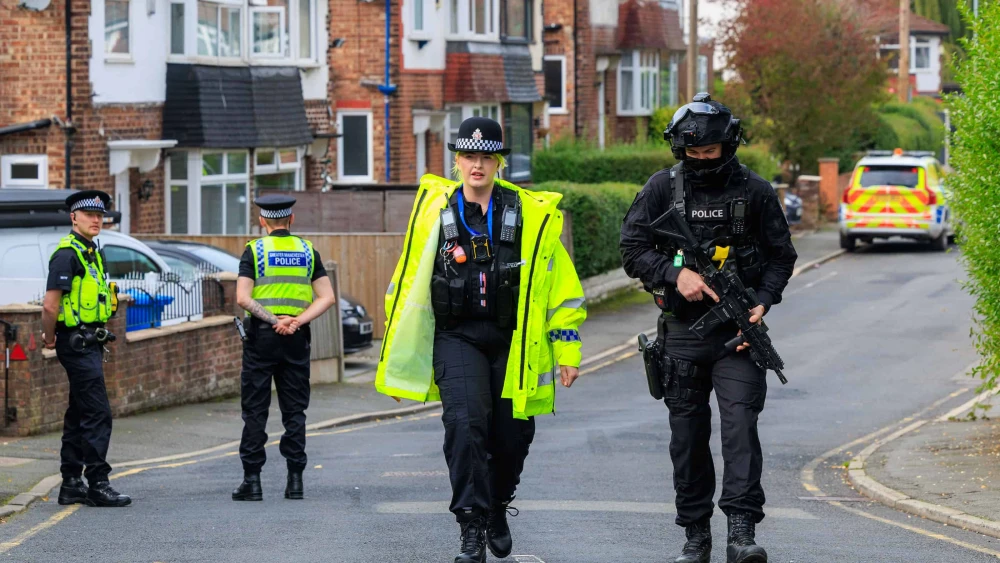
Across the continent, synagogues and Jewish schools sit behind blast barriers, reinforced gates, controlled entrances, CCTV cameras and, in some cities, armed police or military protection. Events are publicized late, addresses withheld and unfamiliar visitors vetted. Measures once imposed temporarily after a terrorist threat have become part of the permanent architecture of Jewish life.
They have entered the Jewish psyche, too. When a siren sounds during prayers, a police vehicle suddenly pulls up outside a school or someone lingers too long by an entrance to a community center, the fear is no longer of disorder but of murder.
The attack on Heaton Park Hebrew Congregation in Manchester on Yom Kippur last year, in which two worshippers died, made that fear horribly real. Now two Iranian nationals stand accused of preparing another attack on Manchester’s Jewish community after allegedly conducting hostile surveillance of the same synagogue and Jewish museum.
Europe’s test is not how many armed officers it can place outside a synagogue.
The price is paid throughout communal life. Money that should employ teachers, care for the elderly and sustain youth programs is spent instead on guards, surveillance, hardened entrances and emergency planning. Large communities can absorb some of this. For smaller congregations, security can consume the resources needed to remain viable.
But the greater rupture lies beyond the security gates. For much of the post-war era, European Jews understood where their most obvious enemies stood. Neo-Nazis glorifying Hitler, Islamist extremists preaching violence and conspiracy theorists existed on the fringes. They were dangerous, but not respectable. Jews trusted that the center would hold.
That confidence has been badly damaged. Governments are entitled to criticize Israel, but a line is crossed when hostility toward an Israeli government becomes hostility toward Zionism itself, when such hostility becomes an oversized obsession, and when Jews are expected to repudiate a central element of modern Jewish identity before they are considered morally acceptable.
The same phenomenon has entered universities and cultural life. Jewish students are asked to explain Israel before anyone asks what they themselves believe. Israeli academics find collaborations questioned. Jewish artists and writers see invitations disappear and face boycotts and assaults.
The exclusion is rarely explicit. Instead, something more insidious emerges: conditional acceptance. You may belong, provided you are sufficiently distant from Israel, sufficiently apologetic and sufficiently unlike the Jews whom fashionable opinion has decided to condemn.
The institutions European Jews once expected to defend them against prejudice can themselves become places in which Jewish identity is treated with suspicion. Its effects are visible in personal decisions. A man covers his kippah before boarding a train. A Magen David disappears beneath a shirt. Parents warn children not to speak Hebrew too loudly. Families who assumed their future in Europe was settled begin discussing emigration. They thought such conversations belonged to their grandparents’ generation.
Yet Jewish life has not retreated. In many communities, Oct. 7 has strengthened Jewish identity. People who drifted away have returned to synagogues; younger Jews speak more confidently about who they are; communities cooperate across borders with new intensity. Our partnership with the Muslim World League and Sheikh Dr. Mohammed Al-Issa shows that Jews, Muslims and Christians need not accept permanent confrontation as Europe’s future.
Europe’s test, therefore, is not how many armed officers it can place outside a synagogue. A continent cannot congratulate itself on protecting Jewish life if its synagogues become fortresses while Jews feel progressively less welcome in its universities, culture, politics and streets.
The question after Oct. 7 is more fundamental: Can Jews still belong in Europe without qualification?
The answer will be found in whether the next generation inherits Europe’s freedoms, or merely the security apparatus now required to exercise them.