
Start with the number: 51.9%. That is the percentage of faculty and institutional records in American Jewish, Israel, Hebrew and Holocaust studies programs that contain a documented, public anti-Israel signal. “Signal” does not mean a private opinion. It means a signature, title and often an endowed-chair affiliation.
The figure of 51.9% comes from a “Who Teaches Judaism in America?” audit by my foundation, which we believe is the largest publicly documented review of Jewish and Israel studies faculty to date. The audit reviewed 2,499 faculty and institutional records in the fields intended to educate Americans about Judaism and Israel. It cross-referenced every identifiable professor against nine petition campaigns from May 2021 through spring 2026.
Let’s be precise about what counts as a “signal.” It requires something very explicit: Endorsing BDS, describing Zionism as “settler colonialism,” accusing Israel of “genocide,” using “Jewish supremacy” to describe the prevailing ideology of the Jewish state, endorsing academic boycotts of Israeli universities or membership in the organizations Faculty for Justice in Palestine or Jewish Voice for Peace.
We specifically excluded things like supporting a two-state solution, criticizing an Israeli government or prime minister, opposing settlements or calling for accountability regarding civilian casualties. The bar was deliberately set very high. Yet half the field cleared it anyway.
The numbers don’t lie: 1,298 academics have documented anti-Israel opinions. Narrow this to professors specifically teaching Jewish Studies, Israel Studies, Hebrew or the Holocaust, and 39.5% have such opinions. Go to the Ivy League and the number nearly doubles to 72.3% or 240 out of 332 records. Moreover, the academics in question are not fringe adjuncts. They are the tenured core of the field.
However, the single most important finding was not a number but a trend: Each successive anti-Israel campaign has been larger than the last and gained more Jewish faculty support.
In May 2021, roughly 100 Jewish Studies faculty signed the foundational “Statement on Israel/Palestine by Scholars of Jewish Studies,” which called Zionism a “settler colonial” project that sustains “Jewish supremacy.”
In late 2023 and early 2024, four anti-Israel “Academics for Peace” petitions garnered 700 to 1,300-plus signatures each. In May 2024, some 1,200 Jewish professors signed a statement opposing the IHRA definition of antisemitism. In March 2025, a letter titled “Not in Our Name” received 3,400-plus signatures. It was the most popular Jewish faculty petition ever recorded.
National barometers rate campuses on a scale that reaches its highest point at “extreme.” However, the label is less informative than the raw counts beneath it; so, it’s worth examining those counts for a more accurate assessment.
Our study documented anti-Israel signals at 313 institutions. The heaviest concentrations were at Columbia University (41), Princeton University (35), Pennsylvania State University (32), New York University (31), Yale University (30), the University of Chicago (28), Brown University (27), the University of Michigan (26), the University of California Berkeley (25), and the University of California Los Angeles, Stanford University and the University of Washington (24 each).
None of these signals came from obscure programs. They came from the flagship departments to which American Jewish families spend six figures to send their children.
Moreover, the number of signals corresponds to the number of Jews on campus. Of the 30 institutions rated most extreme, 20 are from the top 60 American schools by Jewish student population. The problem is worst exactly where the most Jewish students are located.
Faculty are not bystanders, but a leading indicator of anti-Jewish hostility on campus.
The professors in question have, in total, signed on to nine campaigns against the Jewish state. Yet they have not organized, circulated or signed a comparable letter defending Jewish students on their own campuses.
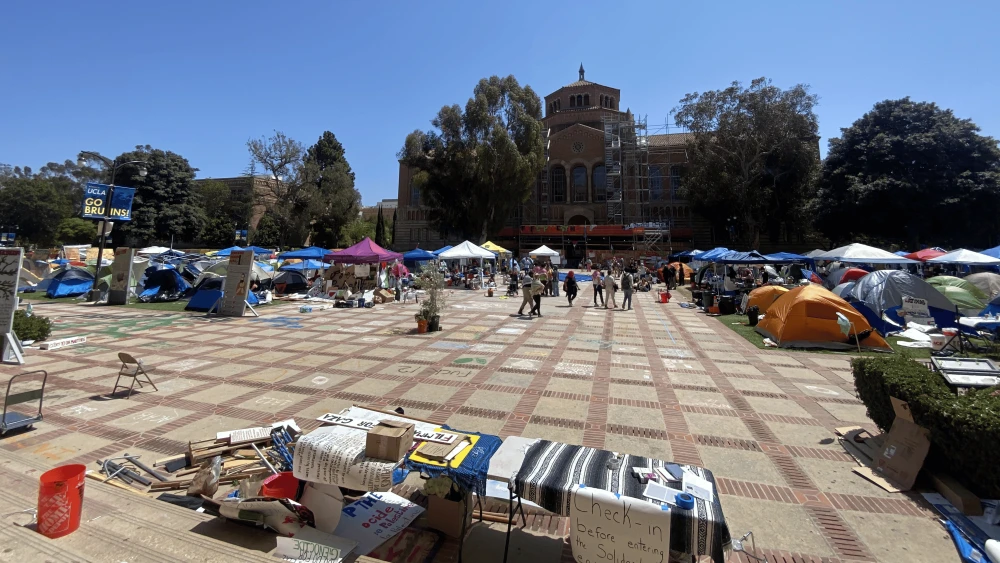
When Jewish students were harassed, encampments blocked their path to class and “globalize the intifada” was chanted outside their dorms, the very faculty that teaches Jewish and Israel Studies did not support them. The petitions flowed in one direction only.
The AMCHA Initiative, which combats antisemitism in higher education, found that one-third of Jewish college students said their own faculty promotes antisemitism and fosters a hostile learning environment. Yet the professors paid to be these students’ intellectual guardians have, in massive numbers, been on the other side of the barricades or nowhere at all.
That is the problem that no statistic can capture: It is not only what these professors signed. It is what, over years of Jewish students under siege, they never bothered to sign.
Let’s follow the anti-Israel trend to the one field that exists solely to say “never again.” In August 2025, the International Association of Genocide Scholars passed a resolution declaring that Israel had committed genocide in Gaza. This did not happen in a vacuum. Raz Segal, an endowed professor of Holocaust and Genocide Studies at Stockton University, published “A Textbook Case of Genocide” on Oct. 13, 2023—six days after the Hamas-led massacre in southern Israel on Oct. 7, 2023. Sixty Holocaust scholars signed a letter backing him. A statement signed by 800 scholars followed. The University of Minnesota offered Segal the directorship of its Holocaust center, then rescinded it. He promptly signed the “Not in Our Name” petition as signatory number eight.
Endowed chairs followed suit. Frances Tanzer, the Rose Professor of Holocaust Studies at Clark University, became the second signatory of the “Not in Our Name” petition. Nitzan Lebovic, the Apter Chair of Holocaust Studies at Lehigh University, also joined the cause. Alon Confino, the PenTishkach Chair at the University of Massachusetts Amherst, also signed the petition. These are not anonymous figures; they are the faces of Holocaust education in America.
Fourteen holders of endowed chairs—positions funded by Jewish philanthropists to strengthen Jewish education—were among the signatories, including the Yerushalmi Chair at Columbia, the Meyerhoff Chair at Penn and the Gilbert Foundation Chair at UCLA. Donors give millions to Jewish scholarship, but the names of the recipients now sit atop letters calling Israel a product of racial supremacy.
These numbers are not just about academic opinion or bias. They have real-world consequences. Research cited in our audit found that antisemitic incidents are 7.2% more likely on campuses with five or more BDS-supporting faculty. The presence of a Faculty for Justice in Palestine chapter raises the likelihood of physical assaults on Jewish students by more than seven times. The group now has over 130 chapters.
In other words, faculty are not bystanders. According to the data, they are a leading indicator of anti-Jewish hostility on campus.
This problem cannot be solved by the institutions themselves. The professors in question are tenured, cannot be fired for signing a petition and will not resign. The academic establishment protects them, even as it turns a blind eye when dissenting Jewish and Israeli academics are purged. The American Jewish Studies infrastructure is not reformable on its own terms. The institutional capture is so complete, the tenure protections are so robust, and the incentives are so aligned against Israel that it is impossible for things to change on their own.
However, the failure of American Jewish Studies is an opening for Israeli universities. Bar-Ilan University, Hebrew University, Tel Aviv University, the Technion, Haifa University and Ben-Gurion University teach Judaism, Hebrew, Israel Studies and the Holocaust in the country against which American professors sign petitions. They teach in the language. They teach on the ground.
These institutions should be building their English-language, online degree and semester study-abroad programs. This will give American Jewish families an alternative to the captured institutions documented in our audit.
Authentic Zionism rooted in Hebrew, the land and the lived experience of Jewish sovereignty is not going to come from Columbia’s Yerushalmi Chair or UCLA’s Leve Center. It is going to come from Jerusalem, Tel Aviv, Haifa and Beersheva. The question is whether Israeli institutions will seize the market that American Jewish Studies has abandoned.
The complete audit can be viewed here.