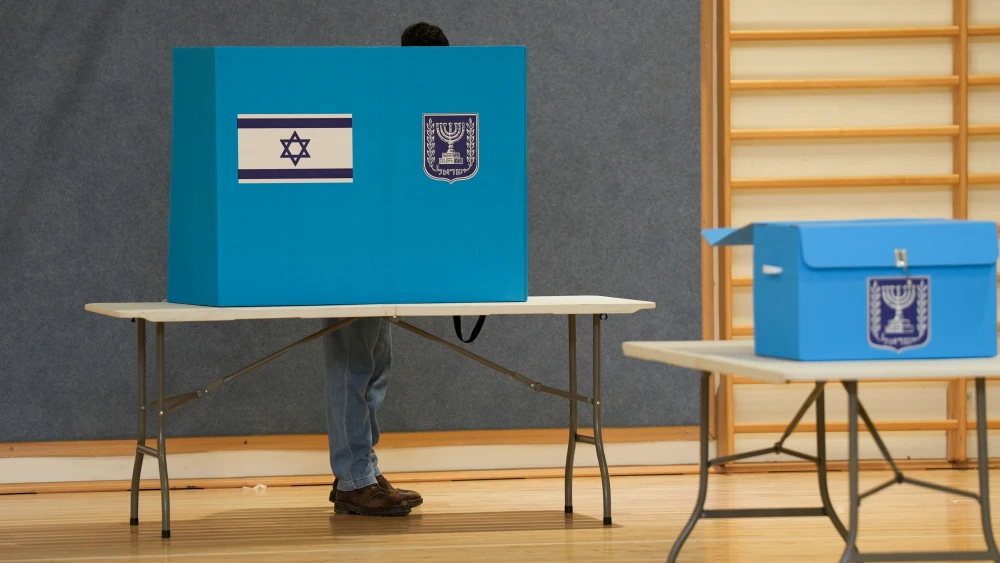
Israeli Election: A record number of Israelis living abroad have returned to Israel to participate in this high-profile election as absentee voting, common in U.S. elections, is not an available option. As this edition was being published, polls in Israel were closing. Reports reflect historically high voter turnout for both Jewish and Arab Israelis. As of 8 p.m. IST, some 74.3% had voted—8% higher than in previous elections and the highest figure since 1988.
The cost of living and allegations of government corruption are top concerns for both Democrat and Republican voters heading into U.S. congressional midterm elections on Nov. 3. American Jewish voters share those concerns, but they also are torn between party loyalty and the dividing lines made by extreme candidates with strong positions on Israel and the conflict with Iran. Anti-Jewish hate is yet another major concern for them at the polls.
These fears are reinforced when political candidates invoke stereotypes and tropes in their campaign ads and speeches. Many American Jews are anxious about how the election results will affect their personal lives, the Jewish community and America’s future.
Issues that affect Jews and Israel even appear in races for city councils, school boards and county clerks. They decide what is taught in classrooms, how a community is policed and how an election is run. These local races are where many officials start on a path that leads to state houses and Congress.

Jews historically scapegoated in political campaigns
Blaming Jews for a nation’s troubles has been a standard American political practice, fueling campaigns for more than a century. This trend has only accelerated, particularly since the Hamas-led terrorist in southern Israel on Oct. 7, 2023, with an unprecedented wave of hatred and violence against Jews and Israel.
A political action committee released a campaign ad in support of Michigan’s Democratic U.S. Senate candidate Dr. Abdul El-Sayed, a Muslim. The Michigan campaign ad blamed the cost of living on Israel’s influence on the American economy—an antisemitic tactic that goes back centuries, most notably with the rise of the Nazi Party, later embodied in Soviet propaganda and even in the United States.
The ad shows a woman telling her husband they cannot afford to buy eggs and bananas because their money is being spent killing Palestinians. The cost of bananas has plummeted over the past 40 years, but that fact didn’t stop anti-Zionist opportunists from manufacturing and promoting anti-Jewish propaganda. When an activist announced the ad on social media, he blamed American suffering on Israel “buying politicians.” El-Sayed’s campaign distanced itself from the ad but did not condemn it.
A similar accusation ran through a Republican primary in Kentucky. Rep. Thomas Massie (R-Ky.) accused the Republican Jewish Coalition of running his opponent as a “puppet.” At a rally days before losing his seat in May, he said that “they gave me the number to call to concede. The area code is Tel Aviv.” A PAC aligned with his campaign ran an attack ad picturing Jewish donor Paul Singer behind a large, rainbow-colored Star of David.
Candidates peddling antisemitic tropes reach large audiences that support their views. Nearly one-third of Americans say Jews have too much influence in politics and media—30% of Democrats and 28% of Republicans, according to an Anti-Defamation League survey from last year.
AIPAC becomes the common enemy
Some Democratic and Republican candidates are telling voters that AIPAC buys Congress. The American Israel Public Affairs Committee (AIPAC) is an American organization that works with both parties to strengthen the U.S.-Israel relationship and backs candidates who support it. AIPAC recently announced an end to candidate endorsements and PAC contributions to allies, citing a new strategy to “fight for the future of the country and the U.S.-Israel alliance.”
Anti-Zionists on both sides falsely describe it as a foreign hand in U.S. governance.
New York City Mayor Zohran Mamdani called AIPAC “monsters” who “move millions in dark money” to preserve their own power, speaking at a Democratic Socialists of America rally in Brooklyn, N.Y., earlier this year.
In Ohio, at least 10 candidates from multiple parties attended a conference billing itself as “the first bipartisan event uniting America First candidates and influencers opposed to AIPAC, endless wars and the Epstein cover-up.”

Both parties push back
Sen. Ted Cruz (R-Texas) remarked that antisemitism on the right is worse than at any point in his lifetime. “The Groyper problem is real,” he said, naming the followers of white nationalist Nick Fuentes, a Holocaust denier. Cruz described how young job applicants to his office now object to his support for the State of Israel.
Sen. John Fetterman (D-Pa.) drew his line in the Democratic Party, saying at a summit in Washington, D.C., that “if our party ever officially becomes the anti-Israel party, that’s when I would leave.” He called his support for Israel a position of “moral clarity.”
Never in U.S. history have voters in both political parties been so strongly opinionated and divided over their views on Israeli policies and the war with Iran. Americans can no longer afford to vote along party lines without doing their research before Election Day on individual candidates and the values that drive them. Even state and local candidates have taken extreme positions on these issues, highlighting the importance of international issues to domestic voters.
Points to consider:
1. The First Amendment gives Americans a voice; voting gives it weight.
The First Amendment guarantees every American the right to speak, worship, assemble and petition the government. Those rights do not enforce themselves. The people elected on Nov. 3 write the laws, set the budgets and appoint the officials who decide how those freedoms hold up in practice. On Nov. 3, Americans will be electing the entire U.S. House, a third of the Senate, governors, state legislators and thousands of local offices.
2. A party label no longer tells you where a candidate stands.
Candidates who share a party do not necessarily share a policy or even the same values. Some have condemned Jew-hatred inside their own party; distressingly, others have promoted the people spreading it. The only way to know is to research what each candidate has said and done: campaign ads, press statements, social-media posts and the company they keep. A straight party-line vote does not ensure shared views on important policies, like antisemitism or Israel.
3. Congress decides how America defends itself and stands with Israel.
U.S. senators and representatives determine funding priorities for national defense, international aid and foreign policy. Foreign-policy trails healthcare, education and immigration as a voting issue, but it has been thrust into the national spotlight by public opinion about Israeli government policies and the war with Iran. Defense support for Israel has become a partisan issue within both Republican and Democratic parties.
4. Each party must confront the extremists inside its own ranks.
Condemning the other party’s extremists costs a candidate nothing. Confronting their own can cost votes, donors and staff. Antisemitism takes hold in a political party when the mainstream treats it as someone else’s problem. Anti-Jewish hate shows no loyalty to any one party; it can put down roots anywhere and spread rapidly.
5. Local offices make the decisions that can impact daily Jewish life.
School-board policies determine what curriculum children are taught about Jewish history and Israel; state and city governments are responsible for ensuring the safety of places of worship. These offices set curriculum and staff security patrols, and they often draw the least attention on a ballot.